


МЕДИЈИ

Борис Кандолф
Борис Кандолф
Whiteness of Whiteness
Streaming Silence in 24 fps
Павиљон у Тврђави, 15. октобар – 8. новембар 2026
отварање изложбе
15. октобар у 19 сати
У четвртак 15. октобра у 19 сати, у Павиљону у Тврђави биће отворена изложба инсталација и принтова Бориса Кандолфа, под називом Whiteness of Whiteness-Streaming Silence in 24 fps.
Поједина дела рецентног циклуса Бориса Кандолфа бублика у Нишу је могла да види у оквиру више издања изложбе Нишки цртеж, као и у оквиру изложбе Мера граница – Избор из актуелне уметничке праксе Ниша. Актуелном поставком Whiteness of Whiteness-Streaming Silence in 24 fps у Павиљону у Тврђави, дају се значајни увиди у овај део опуса аутора.
У целости наводимо уметничку изјаву о овом пројекту:
Бело је увек нечије - бело платно, бели зид, бели снег. Оно припада површини, држи се за предмет као што се име држи за лице. И управо ту почиње пут: не као ход кроз простор, већ као полагано скидање онога што светлост користи да би била препозната. Јер светлост сама по себи нема боју; боја је маска коју јој материја намеће, компромис између извора и ока које још не уме да гледа директно. Када се те маске почну осипати - када облик изгуби оштрину, када се име одвоји од ствари, када се сећање раствори у самом тренутку гледања оно што остаје више се не може назвати белим, јер нема чега да буде својство. То је белина: не боја, већ одсуство свега што је боју чинило могућом. Али ни белина није крај. Она је још увек нешто што се "види", још увек предмет погледа, још увек оно "тамо" наспрам онога "овде". Обрт настаје тек када се и та последња разлика уруши. Домашити,„Белину Белине" не значи стићи некуда дубље, већ доживети преокрет самог чина гледања - тренутак у којем се маска скида са самог посматрача. Око које је до малопре тражило белину у свету одједном схвата да је и оно само део те белине, да између њега и онога што види више не стоји ниједна опна, ниједан слој, ниједно име. Посматрач и посматрано постају једно, јер нема више ничега - ни боје, ни облика, ни простора између - што би их држало раздвојеним. И зато се до „Белине Белине" не стиже кораком, већ перцептивним обртом. Пут од белог до белине јесте пут скидања; али сам сусрет је тренутак у којем схваташ да онај који скида и оно што се скида одувек бејаху исто. Остаје само извор, огољен и непосредан - светлост која више не пада на нешто, већ једноставно јесте.
Борис Кандолф је рођен 1959. године у Нишу. Дипломирао је 1985. године на Академији ликовних умјетности у Сарајеву, одсек графика.
Од 2000. до 2024. године је радио у Уметничкој школи у Нишу као професор стручних предмета.
Од 1986. излаже на колективним изложбама у земљи и иностранству.
Учествовао на Art Fairs (са Галеријом ЗВОНО):
2005 – 2008. Viennafair
2007, 2008. Art Moscow
2006, 2007. Art Cologne, Келн
- Kunstart, Болцано
- Imago Mundi - Luciano Benetton Collection, Сарајево
- Imago Mundi - Luciano Benetton Collection, Трст
Самосталне изложбе:
- „Осијечко љето младих 86“, Студентски културни центар Осијек
- Галерија Дома омладине, Београд
- Галерија Дома младих, Сарајево
- Галерија ЗВОНО, Београд
- Галерија ЗВОНО, Београд
- Галерија ЗВОНО, Београд
Награде:
- Друга награда за проширене медије на Међународном бијеналу уметности минијатуре у Горњем Милановцу
- Прва награда на изложби „Нишки цртеж“ у Нишу
- Трећа награда на изложби „Слике транзиције“ у Нишу


Nikola Macura
SALON 77
The exhibition is realized in collaboration with the International Nišville Jazz Festival; the opening itself will feature a performance involving Niš-based jazz musicians playing on sculptures created by Nikola Macura. The exhibition is part of the exhibition program of the Gallery of Contemporary Fine Arts Niš and the program of the Nišville Jazz Festival.
Nikola Macura is a contemporary Serbian sculptor and multimedia artist best known for his authentic, socially engaged, and innovative approach to sculpture and sound. Through his work, he successfully bridges and merges art, recycling, and peace activism.
The exhibition is titled "From Noise to Sound"—or, more aptly, "From Weapons to Musical Instruments." His artistic concept is based on collecting decommissioned military weaponry and equipment (helmets, shell casings, mortar tubes) and reshaping them into functional musical instruments (wind, string, and percussion). The core idea is the transformation of symbols of war and destruction into tools for creation and art—turning objects designed for destruction, noise, and suffering into objects that produce music and harmony. The works are interactive and sonic, combining visual art forms with acoustics and materializing through musical performances at the opening itself. Nikola Macura arranges these sound objects—sculptures—within the gallery space to form an ensemble he calls the "Rusty Orchestra." It consists of four sound objects played by four professional musicians during the exhibition opening.
The *Bombophone* is one of the most striking instruments from the "From Noise to Sound" project. It was created by transforming decommissioned military components—primarily parts of aerial bombs, rockets, and heavy shell casings—into a melodic instrument. The exhibition features drawings, video works, and sound objects that are closely interconnected, forming a cohesive whole. Thus, while the sculpture takes center stage, the drawings and video works imbue it with a complete narrative and socio-artistic resonance.
The drawing represents the initial concept—the mental spark—that drives the artist to transform military weaponry into a functional art object. The sculpture serves as the focal point of materialization and acts as a medium or prop designed not merely to sit on a pedestal, but to facilitate action, performance, and interaction with the audience or musician; meanwhile, the video work provides documentation of the performance and introduces a temporal dimension. Nikola Macura’s peace activism is not merely an afterthought or a declarative statement in an exhibition text; it is the very core of his creative practice. As both an artist and an activist, he employs sculpture and sound to effect a radical transformation: he successfully strips artifacts of war of their destructive power, transmuting weaponry into a universal language of peace and creativity.
Nikola Macura (b. 1978) holds a Master’s degree in Sculpture and serves as an Associate Professor at the Academy of Arts in Novi Sad. Since completing his studies, he has actively exhibited his work in both group and solo shows, domestically and internationally. In 2000, he participated in the major *Led Art* performance project "Kunstlager," and from 2003 to 2013, he was continuously involved with the "Art Klinika" Multimedia Center. He realized his first public space installation in 2002, and in 2003, he exhibited the first in a series of interactive, process-based works titled "Interactive Sculpture." To date, he has executed numerous interventions and installations; his latest project—currently in progress—explores the relationship between sculpture and sound, specifically focusing on the process of redesigning military artifacts into sound-producing objects. Nikola Macura’s artistic practice bridges various media, encompassing installations, spatial interventions, sculpture, and drawing—primarily within the realm of socially engaged art.
Educational programs constitute a significant aspect of his work. He has conducted numerous workshops, lectures, and courses, and in 2014, he launched an educational project focused on creating installations and interventions in public spaces.
The exhibition is open to visitors from July 23 to August 16, 2026—every day except Mondays—at the Gallery of Contemporary Fine Arts Niš (Salon 77), located within the Niš Fortress.

Exhibition: Sićevo Art Colony 2025 – Selection of Works from the GSLU Niš Collection, in Zagorje ob Savi
Exhibition: Sićevo Art Colony 2025 – A Selection of Works from the GSLU Niš Collection (Zagorje ob Savi)
July 11 – August 11, 2026
The rich cultural and historical heritage of the Sićevo region—its picturesque landscapes, pristine nature, and centuries-old winemaking tradition—serves as both a challenge and an inspiration for researchers, scholars, artists, and adventurers alike. Situated directly above the gorge carved by the Nišava River—nestled between the northern spurs of the Suva Mountains and the southern slopes of the Svrljig Mountains—lies the village of Sićevo. It is a place defined by distinctive architecture, a Mediterranean climate, and welcoming, friendly hosts. It was here that the first gathering and residency of artists working *en plein air* in the Balkans took place. Inspired by the Barbizon school and driven by patriotism and the ideal of cultural unity and solidarity among South Slavs, the renowned painter Nadežda Petrović—together with colleagues from Slovenia and Croatia—founded the First Yugoslav Art Colony in Sićevo, the precursor to today’s Sićevo Art Colony.
However, the idea of reconvening in this southern village—an initiative of great educational, enlightening, and general cultural significance—could not be realized at the time due to historical circumstances, wars, and widespread crisis. That would have to wait for another era. Nevertheless, Nadežda’s landscape and portrait paintings—born of her connection with the people and nature—endure as a lasting national treasure; imbued with the spirit of Impressionism and heralding the advent of Expressionism, they integrated Serbia into the currents of European art.
These early 20th-century events hold a significant place in the history of national art, establishing Sićevo as an important center for the visual arts. Later, in the late 1960s—amidst broader economic, socio-economic, and cultural development—a need (and, to some extent, a sense of obligation) arose to revive the legacy Nadežda Petrović had bequeathed to the region. Following an initial proposal to establish the event, a group comprising artists, journalists, and cultural and public figures agreed—drawing inspiration from the First Yugoslav Art Colony and the values it championed—that the new colony should retain a Yugoslav character. It was decided that, alongside two participants from Niš, the roster would include two artists from each republic and one from each autonomous province; the colony would focus on the visual arts, featuring painters, printmakers, and sculptors. The Sićevo Art Colony was officially founded in 1964 and has been held continuously every late summer for six full decades. During the first six sessions, 88 artworks were created—works that are now part of the collection of the National Museum in Niš. Challenges regarding material resources, accommodation, and organization threatened to dampen the enthusiasm and determination of Niš artists to ensure the colony's survival; at the same time, these difficulties highlighted the need for an institution dedicated to fostering contemporary visual art, managing the colony, building a collection, and caring for, exhibiting, and studying the artworks. Thus, partly thanks to the colony, the Gallery of Contemporary Fine Art in Niš was founded on June 9, 1970. Since then, 560 domestic and international artists—representing diverse generations and stylistic approaches—have participated in this public, international-scale event, which is overseen by a Council appointed by the City Assembly of Niš. Immersed in an authentic rural setting—surrounded by cliffs, enchanting landscapes, and vibrant colors—and free to explore any themes or motifs, they have enriched the institution’s collection with 950 paintings, prints, new media works, and sculptures; these pieces represent enduring value and constitute a significant part of the city's cultural heritage. The participants of the 62nd edition of the colony, held in 2025—whose works you have the opportunity to view—are: Ana Sluga (Ljubljana), Gordana Kaljalović Odanović, Đorđe Odanović, Ivan Petrović (Belgrade), Olivera Dodić, Dragan Momčilović (Niš), Joškin Šiljan (Grdelica), Đorđe Simić (Loznica), and Jovana Simić (Kraljevo).
Emilija Ćoćić Bilić, Senior Curator

"55 years, 5 collections, 2005 works"
The Gallery of Contemporary Fine Arts Niš is pleased to invite you to attend the ceremonial celebration of the institution's day and the promotion of the monograph titled GSLU Niš 1970 - 2025: 55 years, 5 collections, 2005 works, by Emilija Ćoćić Bilić, on Tuesday, June 9 at 1 p.m. at the Officers' House. With a chronological presentation of the history, cultural climate and social circumstances that contributed to the establishment of a unique institution of museological character in this part of Serbia, the monograph examines the development of the Gallery documented by its exhibition, museological, publishing and informational activities, educational role and events it organizes. A significant segment of the richly illustrated publication is an extensive catalog of reproduced works, presented by collections, with which the GSLU team once again wanted to point out the importance of public promotion of the heritage fund, the necessity of a permanent display and adequate conditions for preservation and protection. The catalog is enriched with photographs of traditional collective exhibitions realized in the last five years, as well as bibliographic data. The publication as a whole is representative of the work and achievements of the GSLU in the field of contemporary creativity, which Niš maps as a significant center of visual arts.
The reviewer Prof. Dr. Jasna Jovanov, museum advisor, Dr. of Arts Slobodan Radojković, full professor at the Faculty of Arts in Niš, and author Emilija Ćoćić Bilić, senior curator, will speak at the promotion.

Milan Tepavac Tarin
Милан Тепавац Тарин
НАКОН УПРАВО САДА
Скупови
Отварање изложбе
4. јун у 20 сати
У четвртак 4. јуна у 20 сати биће отворена изложба Након управо сада, уметника Милана Тепавца Тарина.
Иако она то није у пуном смислу, изложба Након управо сада има ретроспективни карактер и обухвата уметничка дела и документе, којима се прати рад Милана Тепавца од раних осамдесетих година ХХ века до данас. Конципирана кроз мање целине (скупове), она приказује одлике опуса и креативне личности овог уметника.
Осамдесетих година се на пољу ликовне уметности јавља одређени број стваралаца који дела у оквирима фигурације, нове слике, односно на линијама постмодерних и трансавангардних плурализама. У домену сликарства Тепавац је свакако међу њима, али се и куша на пољима видеа, перформанса и амбијенталних поставки, односно синтезе различитих уметничких врста и медија. У овом периоду он ствара дела која јесу референтна за сагледавање уметничког тренутка, па и друштвене климе у Југославији, али превасходно њима је назначена физиономија његовог будућег опуса.
Као стипендиста француске и шпанске владе, Тепавац 1989. борави у Паризу, а 1990. године у Мадриду. Тиме почиње његово дословно упоредо партиципирање на уметничким сценама Београда и Париза. Актуелном изложбом унеколико је представљено сликарство деведесетих, али и вишемедијско деловање. Стиче се утисак да је ово период интензивног стваралачког зрења и кључних технолошких унапређења рада.
Тема историје, њене актуелне, односно будуће релевантности, те ерозије епохалних значења, јавља се средином деведесетих и постаје нарочито важна у уметничком раду Милана Тепавца од раних двехиљадитих до данас. Крупан корак у том смислу уметник чини својом магистарским пројектом, на новоотвореним интердисциплинарним студијама Универзитета уметности у Београду, које окончава 2003. године. Током двехиљадитих се у уметничком раду Милана Тепавца уврежује низ лајтмотива и симбола, те обликовно-наративних сретстава чије ће изражајне и семантичке потенцијале аутор изнова проширивати.
Актуелни Тепавчев континуум одликује синхронитет, фрактаност и сингуларност јер он упоредо ствара, развија и међусобно комбинује различите уметничке целине. Проницљиво, са линчним смислом за хумор и осећањем за детаљ, он приступа феноменима глобалне стварности, чију упутност анализира, а апсурдност неретко демонстрира на повесној матрици.
Милан Тепавац Тарин (Сомбор, 1957) је дипломирао на Факултету примењених уметности и дизајна (1985), а магистрирао вишемедијску уметност на Интердисциплинарним магистарским студијама Универзитета уметности у Београду (2003). Као стипендиста француске владе похађао XXIII Летњи Универзитет, Marly le Роi у Паризу (1989), а као стипединста шпанске владе специјализирао сликарство и графику на Академији de Bellas Аrtеs у Мадриду (1990).
Реализовао је 25 самосталнних и учествовао на великом броју колективних изложби у земљи и иностранству. Аутор је књиге Руке на земљи (Публикум, 2008), као и две позоришне представе Доручак на трави Београд (СКЦ, 1983) и Чекајући визу (Дом Омладине Београд / Беч, 2009). Делима је заступљен у значајним музејским и приватним колекцијама (Музеј града Београда, Колекција Wiener Stadtische, Фонд за младе таленте Моша Пијаде, Cite Internationale des Arts, Париз, Галерија Хаос, Уметничка колекција Work in progress - Šumatovačka, колекција Ликовне јесени, Kirjazovsky Париз, колекција Benetton, колекција Медилс... )
Члан је УЛУС-а од 1985. Оснивач је уметничке групе Шума.
Изожбу Након управо сада публика може посетити до 20. јуна у Павиљону у Нишкој тврђави.
Кустос изложбе је Милан Ристић.

ИЗЛОЖБА ГРАФИЧКЕ ВИЗИЈЕ 8
ИЗЛОЖБА ГРАФИЧКЕ ВИЗИЈЕ 8, ауторски пројекат међународне културне сарадње мр Лепосаве Милошевић Сибиновић
Свечано отварање у уторак 2.јуна у 13 сати, Официрски дом
Галерија савремене ликовне уметности Ниш у сарадњи са Амбасадом Мексика у Србији приређује изложбу Графичке визије 8, која ће свечано бити отворена у Официрском дому у уторак 2. јуна у 13 сати у оквиру програма обележавања славе Града Ниша Светог цара Константина и царице Јелене. Изложба представља ауторски пројекат међународне културне сарадње мр Лепосаве Милошевић Сибиновић, који траје 49 година и популарише актуелну мексичку графичку сцену .
Осми циклус Графичких визија обухвата радове шесторо мексичких аутора: Јулија Акмадева, Дијана Моралес Галисија, Роберта Гарсија Ортега, Едуардо Барера, Ернесто Алва Франко и Корал Ревуелтас Ваље. Њима је заједничко изразито неговање линије као изражајног елемента, који носи виталност и динамику обједињујући избор аутора и дела, пише у тексту каталога ауторка истичући да избор радова није математички збир личних поетика, већ је пулсирајући филтер времена, одговор на изазове и трауме савременог света. Било да су рефлексија сећања мапираних у времену, колористичка импресија или назначен изгубљени простор, карактерише их висока ликовна финоћа и изражени графизам. Сви уметници имају свој начин вођења пера или алатке која оставља линијски траг на плочи, касније репродукован на папиру. Присутна селекција није облик надметања, већ представља вредност савременог колективног наступа, истицање богатства инспирације и могућности графичког израза. Представљене графике чине хомогени дискурс, али имају идентитет, коинциденцију и културну емпатију, успешан дијалог линије и форме, наводи Лепосава Милошевић Сибиновић, напомињући да су оне уједно и показатељ да Мексико негује достојне савремене наследнике чувеног графичара Хосеа Гвадалупеа Посаде.
Изложба ће за публику бити отворен до 13. Јуна.

AUTHOR GUIDANCE AND AWARDS
Professional guidance through the exhibition and awarding of the best work at the 10th Niš Salon: 12/2
The audience was guided through the exhibition by the selectors of the jubilee Niš Salon, Ivona Fregl, an independent curator from Belgrade, and Professor Slobodan Radojković from the Faculty of Arts in Niš.
The winner of the 10th Niš Salon: 12/2 Award is Dušan Stipić Dudwarszky. On behalf of the jury, the award was presented by Radmila Kostić, museum advisor at the SLU Gallery Niš.
The Niš Salon: 12/2, an annual exhibition that includes works by twelve artists selected by two selectors, is being held for the tenth time. The selectors of this year's jubilee exhibition are Ivona Fregl, an independent curator from Belgrade, and Professor Slobodan Radojković from the Faculty of Arts in Niš. In the Ivona Fregl selection, Dragoslav Krnajski, Dušan Stipić Dudwarszky, Sanja Latinović, Nina Todorović, Nina Marić and Danja Tekić exhibit their works, while Slobodan Radojković's selection includes works by Lidija Antanasijević, Vladimir Veljašević, Elizabeta Matorkić Bisenić, Vladimir Milanović, Ivana Milev and Mina Rakidžić Dostanić. The exhibition is traditionally accompanied by the award ceremony for the most successful work. The award for the current Niš Salon: 12/2 was decided by a three-member jury consisting of: Radmila Kostić, art historian and museum advisor at the SLU Gallery, Boris Kandolf, academic artist and M.A. Bratislav Bašić, professor at the Faculty of Fine Arts in Niš. The award went to the artist Dušan Stipić Dudwarski for his work: Metabolism of Narratives.
The jury's minutes state the following: "The artwork Metabolism of Narratives is a spatial installation that problematizes the position of modern man in society in an innovative and thoughtful way. By building a layered field of meaning, the artist introduces the observer to spatio-temporal communication. Thus, with convincing metaphors that possess strong, compressed energy, he questions reality, pointing to the current paradoxes of time. Through clear conceptual articulation, he opens up questions of identity, manipulation, or rather, human existence, developing a critical discourse. Possessing consistency in his work, originality in the choice of materials and an enviable dose of criticality, Dušan Stipić Dudwarszky builds a complex visual language and an authentic stance within the framework of the domestic art scene."
In addition to Dušan Stipić Dudvarski, previous winners of the Niš Salon Award: 12/2 are Anica Vučetić (2016), Čedomir Vasić (2017), Vukašin Milović (2018), Radoš Antonijević (2019), Nikola Marković (2020), Marija Dragojlović (2021), Nikola Džafo (2022), Dunja Trutin (2023) and Biljana Đurđević (2024).
This exhibition of the Gallery of Contemporary Fine Arts Niš can be visited by the public until December 17th at the Officers' House in Niš.

EXHIBITION OF PAINTINGS BY MILJAN STEVANOVIĆ
EXHIBITION OF PAINTINGS BY MILJAN STEVANOVIĆ
Between the Visible and the Implied Aesthetics of Balance in Utopian Visions
on Thursday, November 13, 2025 at 7 p.m., Pavilion in Tvrđava, Galleries of Contemporary Fine Arts Niš
Miljan Stevanović was born in 1991 in Vranje. He completed his basic academic studies at the Faculty of Fine Arts in Belgrade in the class of Prof. Čedomir Vasić, and received his master's degree at the same faculty in the class of Prof. Dobrica Bisenić. He received his doctorate in 2021 in the class of Professor Dr. Vladimir Milanović. He is employed at Metropolitan University as an assistant professor.
He has had seven solo exhibitions in Belgrade, Niš (2018), Novi Sad and Slovakia.
Miljan Stevanović draws his inspiration from nature. Landscape is the occasion and basis of his paintings. He constructs the visual relationship and composition based on the landscape he sees, transforming it into large painted surfaces of pastel colors, without much narration. He deposits, absorbs, refracts the color. Flora is reduced and occasionally emerges from the dreamlike landscape. The landscape is glimpsed from the painted surfaces like ghosts, as in dreams of unclear sequences. Does the artist seduce us with such a scene, drawing attention to the matter that surrounds us and titillating us with a sense of comfort and sweetness, while we are surrounded by beautiful landscapes and divine meadows? Through his works we also feel the smell of ozone, oxygen, fog, but also a variety of plants. He transposes the visual impression into an emotional state. Narrative and mere depiction of nature are negligible for him precisely for this reason, but he places the emphasis on the impression. With a specific way of treating color, through line and pasty brushstroke, he redefines the classical medium of painting. With the harmony of painted surfaces, lines and structures, the artist builds an individual artistic style in his own unique way.
The title of his exhibition is Between the Visible and the Implied: Aesthetics of Balance in Utopian Visions. Utopia is not unattainable but transformation through the act of painting. The lyrical overtone is a visual silence in order to notice the boundary between the visible and the implied.
Thus, Stevanović builds a composition of abstract surfaces, amorphous form in a self-contained effect, resembling a pastel thread embroidery of horizontal rows. The color follows the shadow and shape of the desired scene like a dream or a mirage. Everything seems fragile and tender, emphasizing the spiritual and emotional experience that the artist is having at that moment.
Miljan Stevanović's exhibition will run from November 13 to 30, 2025.

EXHIBITION OF WORKS BY JELENA SIMIĆ
“PERSONAL SYMBOL – CIRCLE DISTORTION”
Jelena Simić was born in 1995 in Blace. She completed her undergraduate and master’s studies at the Faculty of Arts in Niš in the class of Prof. Bratislava Bašić. She is the recipient of the “Diploma to the Best Graduate Student” award from the Faculty of Arts in Niš for the 2020-21 academic year. She is currently pursuing her doctoral studies at the Academy of Arts in Novi Sad. She is a member of ULUS and SULUV. She has participated in around 40 collective exhibitions and has organized six solo exhibitions in Niš, Vranje, Novi Sad, Belgrade, Vrbas and Opovo.
The exhibition “Personal Symbol – Circle Distortion” is closely connected to and inspired by nature, from which the artist accumulates and draws inspiration. Distortion of the Circle, as a symbol, is represented in almost all works, occupying a central place in the composition along with abstract forms. In her works through drawing, graphics, collage and sculpture, the circle transformed into an ellipse connects the entire story, like an invisible thread, building a picture of reduced coloristic value. She uses color selectively as an accent (red and blue). On large surfaces that calm the entire composition, the work is partially divided by areas of applied textile or paper surfaces. By using them, the author emphasizes rusticity and texture, and the visual art itself is richer. We notice the ease in the expression of strong drawing parts that transition into the destruction of the material, by sewing, stabbing, tearing, hatching, gluing, scratching the surface of the painting or drawing, Jelena in this way indirectly suggests and warns of the destruction of nature by man. While on the contrary, by using natural non-painting materials: cotton, jute, papyrus, she explores their artistic, conceptual and communicative powers. The symbolism of the entire project or the artist's message is actually an appeal to the excessive use of plastic waste instead of natural ecological materials. The ellipse is a symbol, a bridge between the conscious and the unconscious. Her communication with nature is continuous, she transposes it into a drawing, painting, sculpture. She transfers her empathy, experiences, feelings to the canvas through line, surface and even color, in her own unique way, she boldly depicts everything she feels, sees and what surrounds her.
The exhibition can be visited by the public until August 3, 2025.
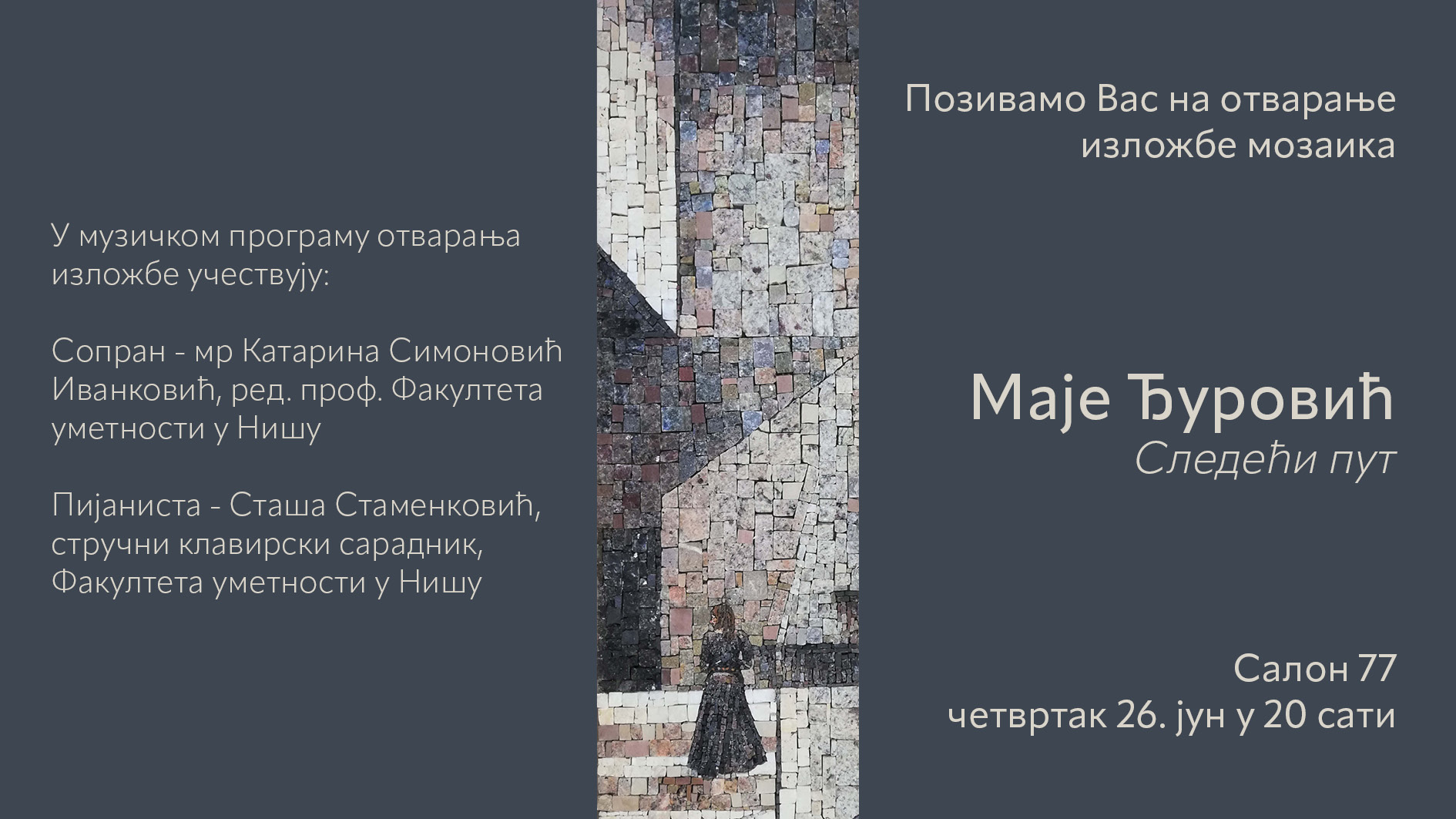
Maja Đurović "Next Time"
Opening of the exhibition on June 26th at 8pm
Exhibition of mosaics by Maja Đurović: “Next time”
Maja Đurović (1977) graduated from the Faculty of Fine Arts in Belgrade, Department of Graphics, in the class of Professor Biljana Vuković. She has been a member of the Association of Fine Artists of Serbia since 2009. She has exhibited at seven solo and over seventy group exhibitions in the country and abroad. She has won several awards for mosaic: FLU Award for Mosaic at the Exhibition of Awarded Students 2005/2006; Plaque for Artistic Contribution to Contemporary Mosaic by the group of fine artists Ametist in Belgrade 2007; Honorable mention at the exhibition of small-format mosaics by the “Ametist” art group in Belgrade in 2011 and an award for exceptional artistic work at the exhibition of the 5th Biennial of Mosaics, organized by the Student Cultural Center New Belgrade in 2012.
She received a commendation for graphics at the 25th October Art Salon in Kovin in 2007; Special recognition for merit at Art Fest & Doral, Miami, Florida, USA, 2012, as well as Plaques from the “Heritage of Metropolitan Pitirim” Fund for the contribution and progress of Serbian art in the Slavic world for participation in the exhibition “1150 Years of Slavic Literacy and Culture”, Moscow, 2013.
For the Tourist Organization of Serbia, she realized replicas: the Medusa mosaic from the ancient settlement of Mediana near Niš and the Venator mosaic from the Felix Romuliana palace near Gamzigrad, 2013. Maja Đurović’s research focuses on the analysis of the inner life of an individual, that is, the state of his or her own being in relation to the environment. Through portrait motifs and human figures, she visualizes the character of the portrayed, emphasizing their individual characteristics. Skillfully handling the technique of mosaics made in natural stone, Maja Đurović presents in a special way her story about passivity, alienation, and apathy in the time and society that surrounds us. The atmosphere is almost elegiac, stopped in a moment that indicates a deep thoughtfulness about one's own existence. All the exhibited works deal with the fate of an ordinary person through visions of lonely, depressed characters who move through the silence of space, wandering aimlessly.
The artistic program of the opening of the exhibition includes:
soprano: Katarina Simonović Ivanković, full professor at the Faculty of Arts in Niš
pianist: Staša Stamenković, professional piano associate, Faculty of Arts in Niš