АКТУЕЛНО

Art colony Sićevo 2024.

The Gallery of Contemporary Fine Arts Niš invites you to the grand opening of the Art Colony Sićevo 2024 on Monday, September 2nd at 7 p.m. - Art Colony building in the village of Sićevo.

The Art Colony Sićevo continues the tradition of the first Yugoslav art colony, founded by the famous Serbian painter Nadežda Petrović. As the oldest colony in the Balkans, it was first held in 1905. Since 1964, when its work was renewed, it has been held continuously every year. Thanks to this event, a collection of 1,000 works of art has been formed and, in terms of its historical, artistic and aesthetic characteristics, it is the most valuable collection of our art from the second half of the century in the territory of Serbia proper.

The colony is held every September in the village of Sićevo, 20 km from Niš. In addition to the artists' stay and work, the Work Program, decided by the Event Council, traditionally includes a more detailed introduction of participants to the cultural and historical heritage of this region. During the ten-day stay, participants have the opportunity to visit the Sićeva Gorge, the surrounding monasteries, and the cultural and historical monuments of our city: the Fortress, Mediana, and the Ćele-kula.

The works of art created during this year's event will be exhibited in the Pavilion in the Fortress in November 2025.

The collection of the Sićevo Art Colony is enriched every year with new works that are left for safekeeping, museological processing, protection, and professional presentation in the implementation of the Gallery of Contemporary Fine Arts in Niš.

The participants of the Sićevo Art Colony 2024 are: Nina Ivanovic, Marija Bogdanovic, Đorđe Stanojevic (Belgrade), Nikolija Stanojevic, Milan Hrnjazovic (Valjevo), Borislav Bozic (Croatia), Dinko Nenov (Bulgaria), Milan Ristic and Tijana Savković (Niš).

The implementation of this year's event was supported by the City of Niš and the Ministry of Culture of the Republic of Serbia.


100 out of 1000 works from the collection of the Art Colony Sićevo


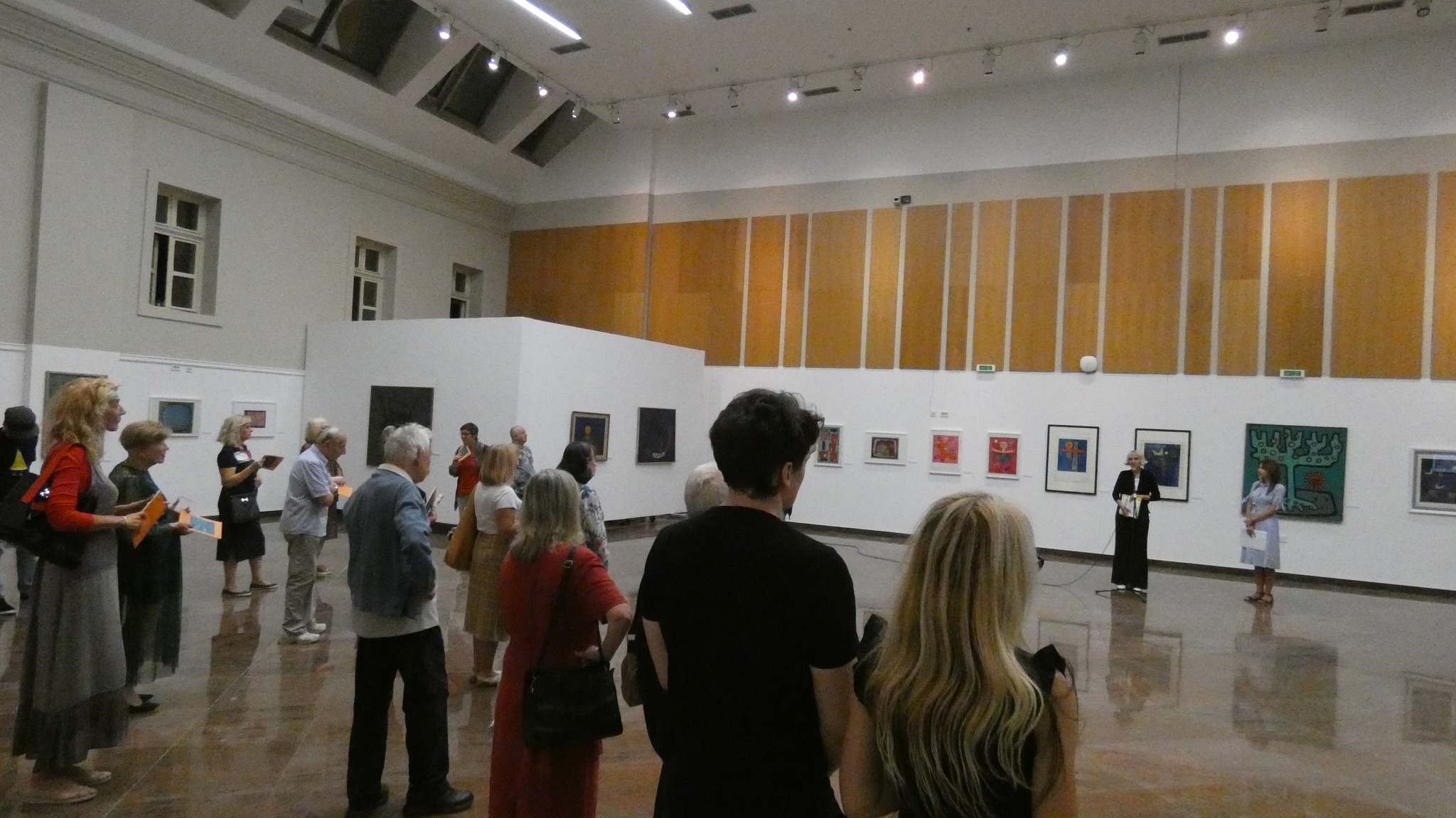
On Thursday, August 29 at 8 p.m., the Officers' Home opened the exhibition "100 out of 1,000 works from the collection of the Sićevo Art Colony" to mark 60 years of regular operation of the Colony.
The exhibition is conceptually designed to follow the chronological sequence of the Colony's existence, illustrating its basic characteristics - Yugoslav and international character, openness to artists of different vocations and styles. The exhibition will be realized through two exhibitions, the first of which is based on works created until 1994, and the second exhibition (September 19 to October 10) includes works from the last thirty years. The author of the exhibition is Milica Todorović, museum advisor.

As the participants of the Sićevo Art Colony were protagonists and actors of numerous parallel existing movements and styles, the exhibition also provides insight into recent movements in art in our region from the 1960s to the present, i.e. from Informel and Tachism, oneiric and metaphysical painting, new figuration, various retro styles of the 1980s and postmodern tendencies, to a new understanding of classical painting and electronic painting, i.e. video.

The idea of ​​our famous Serbian painter Nadežda Petrović about gathering artists in Sićevo, which was realized in 1905 within the First Yugoslav Art Colony, was renewed in 1964 at the initiative of the Society of Fine Artists of Niš, with the establishment of the Sićevo Art Colony. At the time of its establishment, the Sićevo Colony was the first art colony in the territory of central Serbia, and today it is a respectable and longest-running art manifestation of the city of Niš, highly respected in the art world.

The Sićevo Art Colony was initially Yugoslav in nature, and since 1982 it has officially acquired the character of an international manifestation, but inviting artists from abroad has become a regular practice since the early 1990s. A total of 545 artists have participated in the work of the Sićevo Colony so far, of which the largest number were artists from Serbia (285), Niš itself (80), the former Yugoslav republics (70), while 110 artists from many European countries and countries from other continents participated.

In line with the First Yugoslav Art Colony, whose prominent member was the sculptor Ivan Meštrović, the Art Colony Sićevo was open from its foundation not only to painters but also to sculptors and graphic artists, which distinguished it from the colonies of the time that were exclusively for painting (Ilok, Senta, Ečka, Počitelj) or sculpture (Portorož, Dečani, Prilep). Thanks to the Art Colony Sićevo, an impressive fund was formed, which currently has exactly 1000 works of art, of which 88 are kept in the National Museum in Niš and 912 in the collection of the Gallery of Contemporary Fine Arts, given that the Gallery has been managing all the work of implementing the Colony since its foundation (1970). The collection of the Art Colony "Sićevo" is a large, authentic and, due to its historical and artistic characteristics, extremely valuable collection of contemporary art.

Although the organizers of the Colony never conditioned or limited the artists in terms of their choice of themes and motifs, a large number of authors directly reacted to the environment in which they created with their work, whether they used the historical and cultural and artistic heritage of this region for their own inspiring mimesis or the natural environment itself, that is, the landscapes of the unique and unrepeatable Sićevo Gorge. Transposing the vital force of powerful nature into the language of visual elements was a challenge that many artists could not resist, approaching it in an inventive way while respecting personal artistic subjectivity.

The exhibition 100 out of 1000 works from the collection of the Sićevo Art Colony contains works by artists of a wide generational range, from Ivan Tabaković and Mihailo Petrov through the generation of Miodrag Protić, Ksenija Divjak, Mića Popović, Boško Karanović, Bate Mihailović, Stojan Ćelić, Leonid Šejka to all subsequent generations and artists active today. Although the exhibition is based on only one tenth of the works from the collection of the Sićevo Colony, we believe that it provides an adequate insight into the value of the collection, with it we mark the sixtieth anniversary of the Colony's existence, but we also remind you that this priceless treasure still does not have the conditions for permanent presentation.


"Trepča" by Ljiljana Šunjevarić

Trepča by Ljiljana Šunjevarić.

Ljiljana Šunjevarić's latest artistic ensemble will be exhibited for the first time in Niš, at the Pavilion in Tvrđava from August 22 to September 15. With these paintings, the artist remains consistent with issues of social reality, but makes perhaps the first more extensive contribution to understanding the living conditions in northern Kosovo in domestic art. The Trepča Mining Complex, which symbolizes the betrayed ideas of socialist workers' progress, indirectly tells us about the policy of restoring Serbia's sovereignty over the province, from the late 1980s and the more than excessive epilogue from the 1990s. However, Ljiljana's paintings mostly thematize the twenty-year transitional vacuum in this territory, the issues of people's lives and endless expectations. Therefore, the artist paints vedutes of this complex in a hilly landscape, genre scenes from the Trepča restaurant, and portraits of the staff and its guests in muted tones. With the Trepča exhibition, Ljiljana Šunjevarić makes precise but open artistic observations and thus provokes a response from the public consciousness.

Ljiljana Šunjevarić was born in 1979 in Užice. She graduated, received her master's and doctorate in painting from the Faculty of Fine Arts, University of Arts in Belgrade. She has been actively exhibiting at solo and group exhibitions in the country and abroad since 2000. She has been awarded in the field of drawing. She is the author of several art projects in public space. She has participated in numerous domestic and international art colonies and workshops. Her works of art are represented in many collections: Collection of Paintings / Period after 1950 of the Museum of Contemporary Art in Belgrade; Collection of Contemporary Art of the Nadežda Petrović Gallery in Čačak; Collection of the Gallery of Contemporary Art in Zrenjanin; Collection of the National Museum in Arandjelovac; Collection of the National Museum in Smederevo; Collection of the City Museum of Belgrade; Collection of the National Museum in Kraljevo; Collection of Contemporary Painting of the Gallery of Contemporary Fine Arts in Niš and in several private collections. She is employed at the Faculty of Arts of the University of Pristina with a temporary seat in Kosovska Mitrovica, with the title of Associate Professor.


Sofia Vojinović "Daydreams"

Sofija Vojinović ''Dreaming''
SALON 77

Sofija Vojinović, born in 1991 in Čačak. She completed her master's and basic academic studies at the Faculty of Fine Arts in Belgrade, Department of Painting. She is a member of ULUS.
She has participated in several group exhibitions and has realized four solo exhibitions in Užice, Belgrade, Čačak and Kragujevac. Since 2018, she has been starting her exhibition career with drawings in which she explores the shadow. This project has resulted in the cycles Presupposition, Home in the Home, Shadows of Home and the latest Dreaming.

The shadow in Jung's psychology of personality has a deep meaning and the term shadow refers to a part of identity that the conscious self does not understand or accept. Psychic traits that the human ego does not recognize as its own are instead repressed into the unconscious, where an inferior, dark part of the personality called the shadow is formed. What is even more interesting is that the shadow is an inexhaustible source of creativity and often superb art. Shadows are also mentioned in fairy tales and children's stories, let's remember Peter Pan, the eternal boy who chases his mischievous shadow. The shadow can appear in visions, memories and dreams. That is why the artist turned her shadows into memories that, although faded, have remained permanently recorded in special folders and memory cards. A shadow on the wall, a shadow on the floor, a shadow from a window with outlined traces of a curtain through which, as the wind blows, patterns are created on the wall, outlines of silhouettes, geometric and amorphous forms like the shadows of a home. This interweaving represents the memory of childhood, events from the past, beautiful unforgettable moments experienced in youth, in life, but also repressed difficult, emotional moments that occasionally surface.
The latest cycle of Daydreaming builds on previous cycles, shadows revive memories, and new fragments remain framed within the drawing, frozen in time. Daydreaming is a characteristic of artists, poets, inventors, philosophers. Many scientific achievements, imaginary landscapes of visual artists, beautiful symphonies of composers can arise from daydreaming. They have the power to materialize their daydreaming and transform it into a painting, music, or song.
Shadows on walls, drawings, and canvases by Sofija Vojinović represent geometric compositions with a pronounced perspective, painted in gray layers of transparent paint with visible overlapping of crossed lines and surfaces. Discreetly presented combinations of vertical and horizontal surfaces, bordered by a shadow through which light passes, create a certain contrast that is very important in fine art. This contrast enhances the excitement of the composition. However, the artist places special emphasis on the shadow, which is dominant in the entire composition. Judge for yourself whether visualization is the only important thing or the artist is just playing around in order to draw our attention to listening to our Self a little better, and accepting it as it is without any restraints or complexes.


Spreads # ...

JELENA JOCIC EXHIBITION: "PROSTIRANJA"

"SALON 77" /July 16 - August 7/

She was born in Belgrade in 1970. She graduated from the Faculty of Fine Arts in Belgrade in 1997, at the Department of Graphics, received her master's degree in 2000, and received her doctorate and the title of Doctor of Arts at the Faculty of Fine Arts within the University of Arts in Belgrade in 2017. During her undergraduate studies, she was a recipient of a scholarship from the Republic Foundation for the Development of Scientific and Artistic Youth of Serbia. In the period from 1998 to 2002, as part of a project for talented individuals, she worked at the Department of Graphics at the Faculty of Fine Arts in Belgrade.

Since 2003, she has been working as a professor of professional studies at the Academy of Professional Studies Polytechnic, at the Department of Design. So far, she has had several solo exhibitions and over two hundred group exhibitions in the country and abroad. She has exhibited in New York, Paris, Luxembourg, Liege, Quebec, Thessaloniki, São Paulo, Seoul, Madrid, Budapest, Istanbul, Stockholm, Skopje and at many international graphic arts biennials and triennials. She is the winner of several awards in the field of graphic art (Petar Lubarda, Đorđe Andrejević – Kun, 8th and 9th Biennial of Yugoslav Student Graphics).

The most significant awards in the field of graphics are:

The Graphic Collective Mali Pechat Award in 2010 and the Veliki Pechat Award in 2021. The work "Bridges" is in the collection of the Belgrade City Museum. Her works are included in the Purchase of Works of Art of the Ministry of Culture and Information of the Republic of Serbia (2005, 2014, 2015, 2016, 2018). She has been a member of the Association of Fine Artists of Serbia (ULUS) since 1998, and on the board of directors of ULUS from 2022-2023. She has been a member of the Artistic Council and the board of directors of the Grafički kolektiv Gallery in Belgrade since 2011. She was elected as the president of the board of directors of the GK at the GK assembly held on 06.07.2023.

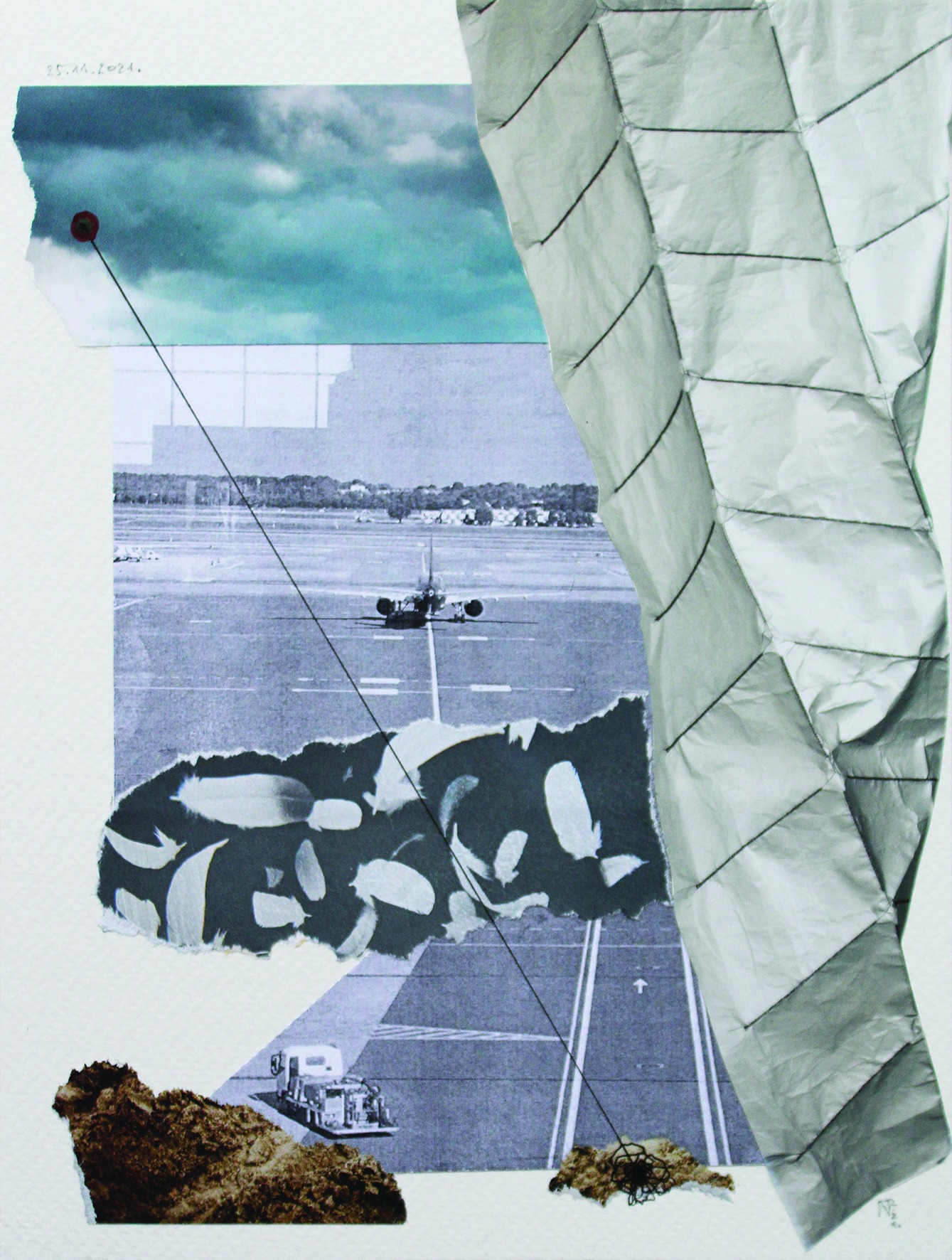
Jelena Jocić continues her artistic research, relating to the existing interiors of large industrial centers, finding in them the idea for defining an ideal space. By merging the visual and the perceptual into one whole, he develops a unique artistic language in whose context visions of an ideal space can be glimpsed. Through his own photographic observation, he singles out the dominant motif of empty, devastated industrial complexes, approaching the framing process that hints at transience, alienation and loneliness. Continuing the process of creation, in addition to nurturing visual relationships, the network of crossed lines and collage pop art pieces also includes a certain number of artifacts.

Through the play of light and geometric surfaces, as well as the assembly procedures used by constructivist artists, he explores the boundaries of personal and private space.

The architectural specificity of the interior, which associates with metal structures, served as a metaphor for the boundary that separates the artist from the existing environment, entering new timeless dimensions.

https://www.youtube.com/watch?v=Lb39KY7LJdE


Exhibition Boško Petrović: Sketches for Great Works

Exhibition Boško Petrović: Sketches for Great Works, Pavilion in the Fortress

The Gallery of Contemporary Fine Arts Niš invites you to the grand opening of the exhibition Boško Petrović: Sketches for Great Works on Thursday, July 11 at 8 p.m., Pavilion in the Niš Fortress.

An extensive opus of drawings for tapestries, sculptures, and mosaics will be presented to the Niš audience thanks to the cooperation of the SLU Gallery and the Museum of Vojvodina, which owns a large number of works by Boško Petrović, on the occasion of an important anniversary - the hundredth anniversary of his birth and forty years since the death of the famous artist.

Boško Petrović belonged to the war and post-war generation of authors who, in the middle of the last century, set out in search of a new, authentic artistic expression. In addition to classical painting, he worked with mosaics, drawings, watercolors, collages, and graphics, and is one of the rare artists who contributed to the development of tapestry and its affirmation.

In order to present the part of the works that presents the creative process and method of work, without emphasizing the subject itself, the author Dragana Garić Jovičić presents the sketches for a monument, a mosaic, and a tapestry in the exhibition Sketches for Great Works. All three works, created in different techniques, were conceived as monumental, but the sculpture was never realized.

The audience will have the opportunity to see for the first time a model of the monument and a map of graphics for the Monument to Slavery, created during World War II, partly as a result of novice artistic searches but at the same time one of the first ideas for a monument to the revolution that emerged in occupied Europe.

In the early 1950s, Boško Petrović began to work intensively with mosaics, primarily small-format portraits in this technique, and part of the exhibition is one of the more impressive sketches for the monumental mosaic that is today in the Assembly of the Autonomous Province of Vojvodina.

A special set of works are sketches on the theme of revolution, made for tapestries and murals, created in the period from 1965-75. The extensive cycle of sketches, together with the monumental tapestry, depicts the dedication and professionalism with which Boško Petrović approached the topic.

According to Dragana Garić, the original, bold and expressive artistic expression of this artist with an exceptionally rich oeuvre has placed him among the most significant Vojvodina artists.

Boško Petrović was a participant in the Sićevo Art Colony in 1975, he organized a solo exhibition in Niš in 1976, and the SLU Gallery has 16 of his works in its collection.

The exhibition in the Tvrđava Pavilion will be open to the public until August 5.

https://youtu.be/1RdpY3jXDWg?si=G-xbmEWe9uFO00XB


Inner sense

Photo exhibition "Inner Sense" by Paulina Aleksić and Sara Popović.

The exhibition "Inner Sense" consists mainly of interpretations of landscapes in the technique of black and white photography. Two significantly different authorial manuscripts by Paulina Aleksić and Sara Popović will offer the audience two positions of opinion on the media and the work.

Artistically sensitive and motifically curious, Paulina Aleksić precisely organizes the frame. Specific and everyday scenes are the subject of balanced conclusions, hunches and questions. Professor Miljan Nedeljković notes how these works delve into collective memory, which the audience intuitively recognizes.

The largest number of Sara Popović's photographs were taken "handheld" and in motion. Sara manipulates nebulae, blur and light with the first line of research, while there is also an enviable group of works with emphasized graphism. By completely ignoring the factual nature of the photographic medium, the artist approaches the expression inherent in traditional art forms or, on the other hand, the aesthetics of new wave film.

Miljan Nedeljković concludes that “The works of the two young authors suggest a return to the idea that life is a constant movement and a sum of what has been experienced, which as such, multiplied by the experiences of generations, build a mosaic of history and the future.”

Paulina Aleksić (Zaječar, 1999) graduated in 2021 from the Faculty of Arts in Niš, Department of Applied Arts, Graphic Design, and completed her master’s studies in 2022 at the Faculty of Applied Arts in Belgrade, Department of Photography. She has participated in numerous exhibitions organized by the artistic student group “PETA 128” and has exhibited her works at various festivals and events.

Sara Popović (Niš, 1997) completed her undergraduate and master's studies in 2022 at the Faculty of Arts in Niš, Department of Applied Arts, Graphic Design. During her studies, she participated in collective exhibitions in the field of graphic design and photography in the country and abroad, as well as in exhibitions organized with the independent art group "PETA 128". Since 2019, she has been actively volunteering as a photographer at the international jazz festival "Nišville". In 2022, the branch of the Serbian Academy of Arts and Sciences Niš published a video work and multimedia entitled "Testimony of Humanity" (P. Donkov, M. Nedeljković, S. Popović).

The first joint exhibition of Paulina Aleksić and Sara Popović "The Inner Sense" was realized in 2023 at the "Čedomir Krstić" Gallery in Pirot, Radul-beg's Residence in Zaječar, the Hajduk Veljko Museum in Negotin and the Gallery of the National Museum in Vranje.

The exhibition "The Inner Sense" can be visited by the public until July 9.


Jeff Sipel and Nebojša Lazić "Meeting Place"

We invite you to the opening of the exhibition of prints by Jeff Sippel and Nebojša Lazić entitled "Meeting Place"

Tuesday, June 4, 2024 at 7 p.m.

Salon 77

Jeff Sippel and Nebojša Lazić are long-time friends and colleagues who have been nurturing a friendship and artistic collaboration for more than thirty years, which began in the 1990s at the Tamarind Institute in New Mexico, United States. The collaboration has been maintained over the past years, through socializing, exchanging ideas in the field of fine graphics, and through the joint work of two artists from different continents. This exhibition, entitled "Meeting Place", continued in Serbia, first at the Small Art Salon in Novi Sad, then at the Sićevo Print Workshop and finally with this exhibition at Salon 77.

Jeffrey Sippel is an international artist and American printmaker. He graduated from the University of Wisconsin-Eau Claire in 1976 and studied at the Tamarind Institute from 1977 to 1979. After graduating from the Tamarind Institute, he received a certificate as a master printer. Later, he received an MFA from the Arizona State Institute. Sippel taught at Druchaus EA Kuensen, worked as the head printer at Ocean Works LEL and taught at Ohio State University. Sippel currently teaches at the University of Missouri, St. Louis. Specializing in waterless lithography, his work is included in many renowned collections, including the Siminsonian Institute. In addition, Sipel's many exhibitions include lectures in the Soviet Union, Finland, South Africa, Chile, Belgium, Poland, Germany, Bulgaria, Mexico, Canada, and elsewhere in the United States. Sipel has exhibited his work in over 200 exhibitions throughout the United States and around the world.

He uses floral motifs, abstracting them in shape and form. He works on paper, mylar, or canvas, combining many different layers of printmaking techniques to achieve the desired effects. He considers his visual explorations to be essential inspiration in his work with students, in collaborations with colleagues, and in his own work. Primarily as a printer, he uses applications, printing cliches, combining different layers that often deviate from the original intention. The fundamental elements contribute not only to the visual but also to the analytical aspect and emotional response.

Nebojša Lazić graduated (1992), received his master's degree (1996) and doctorate (2015) from the Department of Graphics at the Faculty of Fine Arts in Belgrade. During his two-year specialist studies at the Tamarind Institute of Lithography in New Mexico, USA, he earned the title of Associate Printer for Graphics. He has received several awards, scholarships and recognitions for his contribution to fine and graphic arts in the country and abroad. So far, he has organized twenty-three solo and nine author's exhibitions in the country and abroad. He has been a regular member of ULUS since 1993. During his decade-long stay in New York (1995-2006), Lazić founded a professional lithographic studio in which he collaborated as a collaborative printmaker with Rutgers University in New Jersey, the art studio of Donald Bechler, Stefan Dean, Anna De la Porte, Ray Smith, Sinclair Semin... In the professional graphic studio Lower East Side, he demonstrated lithographic techniques. Since 2014, he has been working at the Academy of Arts in Novi Sad as a professional associate in the subject of drawing, and from 2007 to 2014, he worked in the same position at the Faculty of Fine Arts in Belgrade. He currently holds the title of assistant professor at the Department of Drawing at the Faculty of Arts in Novi Sad and at the Department of Graphics at the Academy of Classical Painting at the EDUKONS University in Sremska Kamenica. Lazić is the founder of the Center for Graphics in Novi Sad in 2008, where, through a series of projects in collaboration with domestic and foreign artists, he organized many author exhibitions in Novi Sad, Pym, New York and Munich. He is a participant in numerous professional symposia in the country and abroad. When it comes to his work, he transferred his visual research in the field of lithography to painting. He builds abstract images in layers, by spilling paint on canvas, with expressive gestures. He consciously creates situations of chaos where "the painting paints itself", organizing the achieved randomness into an artistic whole.


GRAPHIC WORKSHOP SIĆEVO 2024.

GRAPHIC WORKSHOP IN SIĆEVO 2024

The International Graphic Workshop in Sićevo officially begins on Monday, June 3, 2024, in the building of the Art Colony, and will last until June 9, 2024.

The following will be staying and working in Sićevo: Jeff Sippel from the United States, Lilya Pavlovic Dear from the French Republic, Jelena Jocić from Belgrade, Nebojša Lazić from Novi Sad, Jasna Gulan Ruzić from Novi Sad, and Slobodan Radojković from Niš.

This is the 22nd gathering of graphic artists in the village of Sićevo in the building of the Art Colony of Sićevo. So far, around 90 artists have worked at the Graphic Workshop, including notable names from the Serbian graphic scene, as well as from Mexico, the USA, Japan, Denmark, Poland, Canada, Belgium, Italy, Slovenia, Bulgaria, and Macedonia. In addition to working in the workshop, the artists will have the opportunity to enjoy the natural beauty of the Sićevačka Gorge and visit significant cultural and historical landmarks in Niš and its surroundings. During the Graphic Workshop, the Salon 77 Gallery in the Niš Fortress will host the opening of the exhibition "Meeting Place" by two of the colony's participants, Jeff Sipel and Nebojša Lazić, on June 4 at 7 p.m. This exhibition will mark the long-standing collaboration between artists from America and Serbia, as well as the cooperation between the two countries for more than three decades.

The exhibition of the resulting works will be presented to the Niš audience next year in the Niš Fortress Exhibition Pavilion.

Biographies of participants of the 22nd convocation of the Sićevo 2024 Graphic Workshop:

Jeff Sippel is an international artist and American graphic designer. He graduated from the University of Wisconsin-Eau Claire in 1976 and studied at the Tamarind Institute from 1977 to 1979. After completing his studies at the Tamarind Institute, he received a certificate as a master printer. Later, he received an MFA from the Arizona State Institute. Sippel taught at Druchaus EA Kuensen, worked as a chief printer at Ocean Works LEL and taught at Ohio State University. Sippel currently teaches at the University of Missouri, St. Louis. Specializing in waterless lithography, his work is included in many renowned collections, including the Siminsonian Institute. In addition, Sipel's many exhibitions include lectures in the Soviet Union, Finland, South Africa, Chile, Belgium, Poland, Germany, Bulgaria, Mexico, Canada, and elsewhere in the United States. Sipel has exhibited his work in over 200 exhibitions throughout the United States and around the world.

Lilia Pavlovic Dear was born in Topola, Oplenac. She graduated from the Academy of Applied Arts in Belgrade. In 1972, as a British Council scholarship holder, she completed her postgraduate studies at the Chelsea College of Art in London, where she remained until 1973. Two years later, at the invitation of the Austrian Ministry of Culture, she participated in the Neu Galerie Johanen museumum art week in Graz. From 1974 to 1977, she worked as a professor at the University of Los Angeles and lived in San Francisco and Los Angeles. Since 1978, she has been living between Paris and Belgrade. Her works are in many private and public collections in Europe, America and China. She has received many significant awards in the country, France, Italy and China for her great contribution to art. She has participated in over 300 collective exhibitions around the world, and has exhibited independently more than fifty times in important galleries around the world. She is included in art dictionaries: Benezit, Paris, Rečnik Akount, Drout Art Market quotations in France. The Niš audience had the opportunity to encounter her works at her solo exhibition that she organized at Salon 77 last year.

Jelena Jocić was born in Belgrade. She graduated from the Faculty of Fine Arts, Department of Graphics, in 1997, and received her master's degree in 2000 and earned her Doctor of Arts degree from the Faculty of Fine Arts, University of Belgrade, in 2017. During her undergraduate studies, she was a recipient of a scholarship from the Republic Foundation for the Scientific and Artistic Development of Youth of Serbia. From 1998 to 2002, she worked at the Department of Graphics at the Faculty of Fine Arts in Belgrade as part of the project for talented individuals. Since 2003, she has been working as a professor of professional studies at the Academy of Technical Professional Studies - Belgrade, Department of Design. So far, she has organized several solo exhibitions and participated in over one hundred and ten collective exhibitions in the country and abroad. She is the winner of several awards in the field of graphic arts. Her works are included in the Purchase of Works of Art of the Ministry of Culture and Information of the Republic of Serbia (2005, 2014, 2015, 2016,2017). She has been a member of the artistic council and president of the board of directors of the Graphic Collective in Belgrade since 2011, as well as of ULUS since 1998, whose board member she was from 2022-2023.

Nebojša Lazić graduated (1992), received his master's degree (1996) and doctorate (2015) from the Department of Graphics of the Faculty of Fine Arts in Belgrade. During two years of specialist studies at the Tamarind Institute of Lithography in New Mexico, USA, he earned the title of associate printer for graphics. He is the recipient of several awards, scholarships and recognitions for his contribution to fine and graphic arts in the country and abroad.


MILORAD BATA MIHAILOVIC

MILORAD BATA MIHAILOVIĆ - THE FIRST PARIS DECADE

The Gallery of Contemporary Fine Arts Niš invites you to the grand opening of the exhibition of works by painter and academician Milorad Bata Mihailović (1923-2011) on Thursday, May 30 at 8 p.m. - Pavilion in Tvrđava. The exhibition entitled The First Paris Decade of Milorad Bata Mihailović, authored by Sofija Z. Milenkovic, is organized by the SLU Gallery in cooperation with the Rome Gallery and the Milorad Bata Mihailović Foundation, on the occasion of the great jubilee, the centenary of the birth of the prominent artist.

The exhibition will feature some of the most significant works of Mihailović's first Paris decade, including newly discovered works, which will be presented to the domestic public for the first time in Niš.

Milorad Bata Mihailović was born in Pančevo in 1923. He began his studies at the Academy of Fine Arts in Belgrade in 1946, but after a stay in Zadar and work within an informal group of students known as the Zadar Group, he left them two years later and continued working independently. In the very early period, Mihailović's paintings were dominated by figures, most often through the genre of portraits, self-portraits and group portraits, as well as urban landscapes, among which Belgrade vedutes stand out. Later, while living on the coast, after leaving the Academy, under various influences, the artist developed his own artistic expression, adopting a two-dimensionality and modernist approach to painting.

From 1951 he was a member and founder of the group Elenaestorica. In the same year, he held his first solo exhibition in Belgrade at the ULUS Gallery, which was met with approval from art critics, with the observation that Mihailović, although obviously talented, had not yet found his authentic artistic expression.

With his wife, the painter Ljubica Jovanović, he went to Paris in 1952, where, with occasional returns to Belgrade, he spent most of his life.

Having entered a new, developed art scene, in the very center of European art events, the artist encountered a variety of currents of abstract painting that were unknown to him until then. Painting initially moderately geometric abstract forms, Mihailović's expressive painterly temperament in Paris was more suited to a freer lyrical expression. He organized his first solo exhibitions as early as 1953 at the Marseille Gallery and the Paul Morihien Bookstore, and his notable performances led him to meet and collaborate with the renowned gallerist Rudi Augustincic and the Rive Gauche Gallery, where he first exhibited with the Polish artist Marjan in 1957, and then in 1959 with the Dutch painter Bram Bogart. Crucial to Mihailović's positioning on the local art scene was his collaboration with Žan Polak, owner of the prestigious Ariel Gallery, where Mihailović has been exhibiting solo since 1960.

He visited New York on several occasions from 1962 until his final return to the Yugoslav art scene in 1965. The first retrospective exhibition in Belgrade was organized in 1981 at the Cvijeta Zuzorić Art Pavilion.

Milorad Bata Mihailović was a member of the Serbian Academy of Sciences and Arts. His works are represented in the collections of renowned museums and institutions, private collections, and social institutions in the country and abroad.

The public in Niš will have the opportunity to visit the exhibition at the Tvrđava Pavilion until June 30.

https://www.youtube.com/watch?v=MHZjSLB2B4A