АКТУЕЛНО
LIDIJA UZELAC'S EXHIBITION: "WHERE I AM"
LIDIJA UZELAC EXHIBITION: "WHERE I AM"
PAVILION IN THE FORTRESS 24 October - 10 November
As a curious artist who always strives for new, exploratory processes, Lidija Uzelac uses various visual techniques: paintings, drawings, canvas printing, layered collage fitting, installations, creating a fresh, innovative system.
Problematizing different ways of reading through enigmatic structures of action, in one part of her latest project she forms free, geometrized forms emphasizing the power of color and lines that possess a wide range of meanings, while in the other part she records her intimate states through a portrait of a Renaissance woman as a personification of mother, woman or matrix, alluding to the source and meaning of existence. Defining the flow of her own thoughts, memories and emotions, she skillfully combines materials to form narratives that relate to the phenomenon and essence of being.
Different levels of meaning invite deeper reflection on the relationship between image and space, reality and illusion, emphasizing elements of property in the current moment.
By arranging very carefully clean, systematically shaped geometrized surfaces and lines through a focused, intimate approach, she forms a complex visual language that functions in the coordinate system of personal symbolism.
Observing the painting process as a mechanism for reading the complex human nature, she expresses a clear personal stance, opposing the increasingly present loss of individual identity. In the title of the exhibition “WHERE I AM”, the artist seeks to establish contact with the viewer by drawing attention to the paradoxes of the contemporary social moment. In addition to abstract paintings and drawings, an independent entity is represented by a wall installation called: "Alma Mater", expressing her fascination with the portraits of women of the Renaissance masters, which remained recorded in her memory since the time of her studies in Florence, as an intriguing motif that for her represents a striking level of meaning related to nature, life, love, truth, wisdom, revealing the deeper truths of human existence.
Expressing a penchant for reduced forms, an analytical, layered approach and thoughtful compositional construction, Lidija Uzelac forms her own positions in the complex perception of the world and art.
Lidija Uzelac (1961. Travnik), graduated from the Academy of Fine Arts in Florence, Department of Painting, and then specialized at the Academy of Arts "Brera" in Milan. She completed her master's degree in the class of prof. Radomir Knežević at the Faculty of Arts in Banja Luka. She has organized 24 solo exhibitions in Pančevo, Pirot, Raška, Plovdiv, Smedrevska Palanka, Niš, Belgrade and over 50 group exhibitions in Serbia and abroad. She teaches at the Faculty of Arts in Niš as a full professor at the Department of Graphic Design in the subject of drawing and painting.
The exhibition will run until November 10.
Aleksandar Dević - retrospective exhibition
Retrospective exhibitions of paintings and prints by Aleksandar Dević, marking the artist's 45 years of creative work.
Aleksandar Dević (1954, Belgrade) graduated in 1978 from the Faculty of Applied Arts in Belgrade, where he also received his master's degree. For a short time, he worked as a professor at the Art School "Đorđe Krstić" in Niš and at the Faculty of Arts, participating in the formation of the Department of Applied Arts of this faculty. From 2000 to 2004, he was the director of the Gallery of Contemporary Fine Arts in Niš, where he also worked as a senior associate of the Internet Communications and Publishing Service and was the editor of the gallery's online magazine IIČ. He has had solo exhibitions in many cities in Serbia and in Greece (Volos), America (New York) and Hungary (Budapest). He has participated in more than 50 collective exhibitions in the country and abroad. He has been a member of the Painting Section of ULUS since 1986, as well as the Niš Graphic Circle. He has won several awards, including: the Redemption Award of the SIZ Culture, Belgrade; the Silver Plaque of ULUPUDS and the Special Recognition of the 45th International Festival of Documentary, Short and Animated Film, Belgrade.
In addition to painting, he also works in computer graphics and web design. His paintings and graphics are in private collections in Greece, Germany, the Netherlands, Denmark, America, and France.
With his decades-long oeuvre, Aleksandar Dević creates and perfects his own world of scenes and visions that are beyond the boundaries of rationalism and perceptual experiences, and under the auspices of imagination and fantasy, which makes him a significant successor to that line of development in our art that was started by Milena Pavlović Barili and Radoica Noe Živanović and applied by the members of Mediala.
From the very beginning, he cultivated a specific approach to figuration. In his earliest works, we can sense the influence of myth, legend, dreams... and in the artistic elaboration, a unique combination of archaism and modernism, rusticity and lyricism. The figure is not only the bearer of the plot, but also a witness and a factor of the ambience that is unusual, fanciful, created from differently treated segments and carries an aura of enigma and mystery. In doing so, Dević stepped into the realm of the surreal and metaphysical, which is the basic characteristic of the entirety of his oeuvre, although during the years of creation, changes occurred in the artistic expression itself, in the iconographic content and artistic structure. The nineties in Dević's oeuvre are marked mainly by graphics of wondrous coloristic harmonies, which exude esotericism and an atmosphere of illusoryness with a dominant impression of sophisticated visual art.
In the paintings created in the last twenty years, Aleksandar Dević has added new varieties and approaches to his artistic "legitimization". Occasionally, applying the principle of displaced quotation, he skillfully combined fragments from medieval or Renaissance art with motifs of different origins, creating dichotomously coded imaginary scenes. His latest paintings are full of some unusual dynamics, bravura "architectural" wonders, phantasmagoric machinery, a metaphysical atmosphere that includes a component of life but also a component of its diabolical destruction. The form is futuristically bold, robotic, disassembled and again assembled from a series of parts and details. Possessing a refined refinement towards semiotically complex symbols, he created a series of paintings of the same motif, which is a precedent in his previous artistic practice. Having skillfully and purposefully chosen the motif of the horse/rider, which has multi-layered meanings, mythological, theological, literary and artistic references (the Trojan Horse, the Holy Warriors, Don Quixote, the wooden horse of Dadaism...), Dević metaphorically raises awareness of various issues of a humanistic and ethical nature, because the time of shaken spirituality and growing technocracy requires a reexamination of existing criteria and values in all spheres, including the field of art. Breaking through the boundaries of the ordinary, Aleksandar Dević has created an opus that is extensive, authentic, meaningfully complex and enigmatic, and artistically precisely elaborated and refined. His works from the mid-19th century, which are a mixture of emotions and dreams, reality and reality, carry a latent mystery, enigma and metaphorical referentiality, making him one of the most original creators, certainly not only of the Niš but also of the national art scene.
The exhibition will run until November 10th.
https://youtu.be/VjD51G2J73o?si=iqO0YPpsVcmPh-MV
SELMA ĐULIZAREVIĆ EXHIBITION
Selma Đulezarević – Karanović was born in Sarajevo in 1967. She studied at the Department of Art History at the Faculty of Philosophy in Belgrade. She graduated from the Painting Department of the Faculty of Fine Arts in Belgrade, in the class of Professor Milica Stevanović. She also completed her postgraduate studies at the same faculty in 1997. She earned a Doctor of Arts degree in painting under the mentorship of Professor Anđelka Bojović in 2012. She has been a member of ULUS since 1995. She currently works at the Faculty of Applied Arts in Belgrade as a full professor. She has had 34 solo exhibitions in Serbia, Montenegro, Bosnia and Herzegovina and Belgium. She has participated in numerous group exhibitions in the country and abroad. Her works are in the collection of the Belgrade City Museum, the Nadežda Petrović Gallery in Čačak, the Contemporary Gallery in Subotica and the Art Gallery of Bosnia and Herzegovina in Sarajevo.
In 2010, Selma Đulezarević Karanović participated in the Symposium of the International Organisation of Scenographers, Theatre Architects and Technicians in Istanbul, entitled Cultural Exchange Between East and West: Kaftan and Its Influence in Fashion. In the same year, she became a member of this organisation. The thematic framework of this symposium had a stimulating influence on her artistic work. Although she is a painter by vocation, she began researching the kaftan, a traditional shirt of the peoples and nationalities from the territory of the former Yugoslavia. Since the author herself comes from Bosnia and Herzegovina, more precisely from Sarajevo, she places emphasis on the urban costume, noticing various depictions and ornaments on the shirts of women of Jewish, Muslim and Christian faiths. One thing was common to all of them, and that was the beauty in the execution of various embroideries and weavings, as well as the dominant floral motif (rose, jasmine, tulip, lily of the valley,..). The importance of folk handicrafts, the richness of weaving in cotton, hemp and silk as well as embroidered decorations on clothing items, shirts, dresses, towels are sublimated in the new opus of Selma Đulezarević Karanović. Following the basic formal principles and patterns in the original embroidery, the artist paints and draws with textile paint floral decorations, song lyrics and messages. Collages made by combining different pieces of textiles have a special charm. This encounter of antiquity with objects of modern clothing creates new horizons not only of the aesthetic but also of the mental concept of a personal nature. The artist uses the white shirt from the folk costume as a metaphor for the permanent and the imperishable, as a symbol of the unbreakable bond of every woman with her mother, grandmother, great-grandmother, generations ago. As the artist herself says, with these works she makes a special kind of gratitude to our ancestors from whom we inherited a sense of beauty. We can freely say that our grandmothers turned manual labor from an everyday necessity into an individual pleasure and a means of expression. Women in domestic conditions, excluded from any socio-political influence and public life of that time, through this type of activity become the forerunners of today's emancipated women. Through various status or romantic messages ("Beauty is within us", "Housewives, talk less so your lunch doesn't burn", "Dew fell on the meadow, I gave my beloved my hand"...) Selma parries the traditional and contemporary position of a business woman, exposed to new global challenges. She has written the verses of Vera Nedić on her wedding towels, her shirts are called "Covid Depression", and her corsets are written with the names of antidepressants. Dresses, collages and other objects make the ambient installation entitled "Heritage-Burden" complex and multi-layered. Going through each segment of the aforementioned works, the artist gives us the opportunity to experience the past and heritage through the prism of the aesthetic, philosophical, material and immaterial segments of our individual and collective heritage, questioning our willingness to accept its weight.
https://www.youtube.com/watch?v=H_uPe1z9XnA
100 out of 1000 works from the collection of the Art Colony Sićevo
The second exhibition of the exhibition "100 out of 1000 works from the collection of the Sićevo Art Colony" will be available to the public from Thursday, September 19, at 10 a.m., at the Officers' House in Niš. The exhibition is of an international nature and consists of works created in the Colony between 1994 and 2024.
The Gallery of Contemporary Fine Arts Niš is organizing the exhibition "100 out of 1000 works from the collection of the Sićevo Art Colony" to mark the sixtieth anniversary of the regular holding of the Colony. The exhibition is designed to follow the chronological sequence of the Colony's existence, illustrating its basic characteristics (Yugoslav and international character, participation of artists of different vocations and stylistic orientations). Due to its large scale, the exhibition is being realized through two exhibitions. The first exhibition (from 29. 8 to 13. 9.) was of a Yugoslav character and included works created during the first three decades of the Colony. The second exhibition is of an international character, since since the beginning of the 1990s, artists from abroad have regularly participated in the work of the Colony. The exhibition is based on works by authors from Serbia and other countries (Japan, Canada, Sweden, Bulgaria...), which were created in the period from 1994 to 2024. The exhibition is also multimedia in nature, because in addition to works of traditional media (paintings, graphics, drawings), objects, video works and video installations are represented, since in the last couple of decades, artists who express themselves through the so-called new media have also been participants of the Colony.
The landscapes of the unique Sićevačka Gorge are a dominant inspiration and a constant artistic challenge for numerous authors. Each of them moved along the selected paths of their own visual poetics in the artistic re-creation of their experience of the gorge, using as an initial impulse a general impression, a panoramic view or just a fragment from nature (Kosta Bradić, Milena Jevtić Nićeva Kostić, Rada Selaković, Zoran Vuković, Miroslav Anđelković, Elizabeth Matje, Kenji Nagai, Branko Nikolov, Sonja Vukašinović, Rajko Popivoda, Jelena Šalinić, Due Martin, Katarina Đorđević, Ivana Stanković, Miroslav Lazović, Slavica Curk, Ljiljana Šunjevarić, the DimTim group...). A number of artists defined their impressions of their stay in the Colony through the symbols of the historical heritage of this region (Čedomir Vasić, Branimir Karanović, Zoran Grebenarović, Jelena Trajković, Vesna Knežević), while others, through works created in Sićevo, pointed to the antagonisms of current geopolitics, social reality, health situations or behavioral psychology (Zlatko Glamočak, Nina Kovačeva and Stefan Valentin, Zoran Veljković, Ivana Ivković, Milica Ruzić, Jovan Spasić, Ivan Milenković).
The author of the exhibition is Milica Todorović, museum advisor.
The exhibition will run until October 10.
Over the sixty years of regular maintenance of the Sićevo Art Colony, an impressive fund of artistic works has been formed, which currently has exactly 1,000 inventory units, of which 88 are kept in the National Museum and 912 in the fund of the Gallery of Contemporary Fine Arts. The most numerous in the collection of the Sićevo Art Colony are paintings (644), followed by graphics, drawings and works on paper (291), sculptures (33), photographs and works of new media (22).
https://youtu.be/jNuIHqy-Mfs
Djordje Djordjevic "Integrity"
Đorđe Đorđević "Integrity"
September 19 – October 14, 2024
After a long time, the artist Đorđe Đorđević will present himself to the public in Niš with an exhibition of paintings, entitled "Integrity". The exhibition consists of works from his current artistic production, including a number of this year's paintings. The exhibition will open on Thursday, September 19 at 7 p.m. in the Pavilion in Tvrđava.
Starting from the mid-1980s, Đorđe Đorđević's abstract painting opus has developed consistently, recording subtle shifts in terms of reducing the palette and repertoire of graphic symbols. Emphasizing the mental and emotional-expressive qualities of Đorđević’s creative personality, art historian Jovan Despotović notes his ability to disregard rules: “It allows him to maintain the pictorial scene in a consistent state in a justified compositional order, despite the risky process of crossing mutually exclusive principles of geometricism and gesturality in the same pictorial field…”.
With his recent painting, Đorđević offers resistance to the deafening hustle and bustle of everyday life. The basic element and unit of these compositions is the quadrangle, which embodies stability and harmony, but also neutrality and subordination to a larger whole. The gesturally treated surfaces, in comparison with the smaller monochrome fields, reflect the artistic principle of the unity of elements and the dominant, and this is also the thesis that the author examines on a semantic level. Therefore, transferred to the field of social relations, it is the principle of collective interests, which implies the discreet correction of the individual desires of the participants, the conscious surrender of part of personal dignity for the sake of the integrity of the community. In his autopoetic text, Đorđe Đorđević emphasizes that catholicity is an acute social need of the time in which we live.
Đorđe Đorđević was born in 1949 in Belgrade. He graduated from the Accademia di Belle Arti di Brera in Milan, Italy, in 1972. From 1974 to 1976, he designed textiles for the leather and textile factory "Viteks" in Visoko, near Sarajevo. He held twenty-five solo exhibitions in Serbia, Italy, Croatia, France, Montenegro and Austria and took part in a large number of collective exhibitions. His works are represented in several public and private art collections. He has been a member of ULUS since 1981, and in 1982 he received the status of an independent artist. He lives and works in Belgrade.
https://www.youtube.com/watch?v=zNAAxyzg2mc
"Liberation" by Maša Paunović
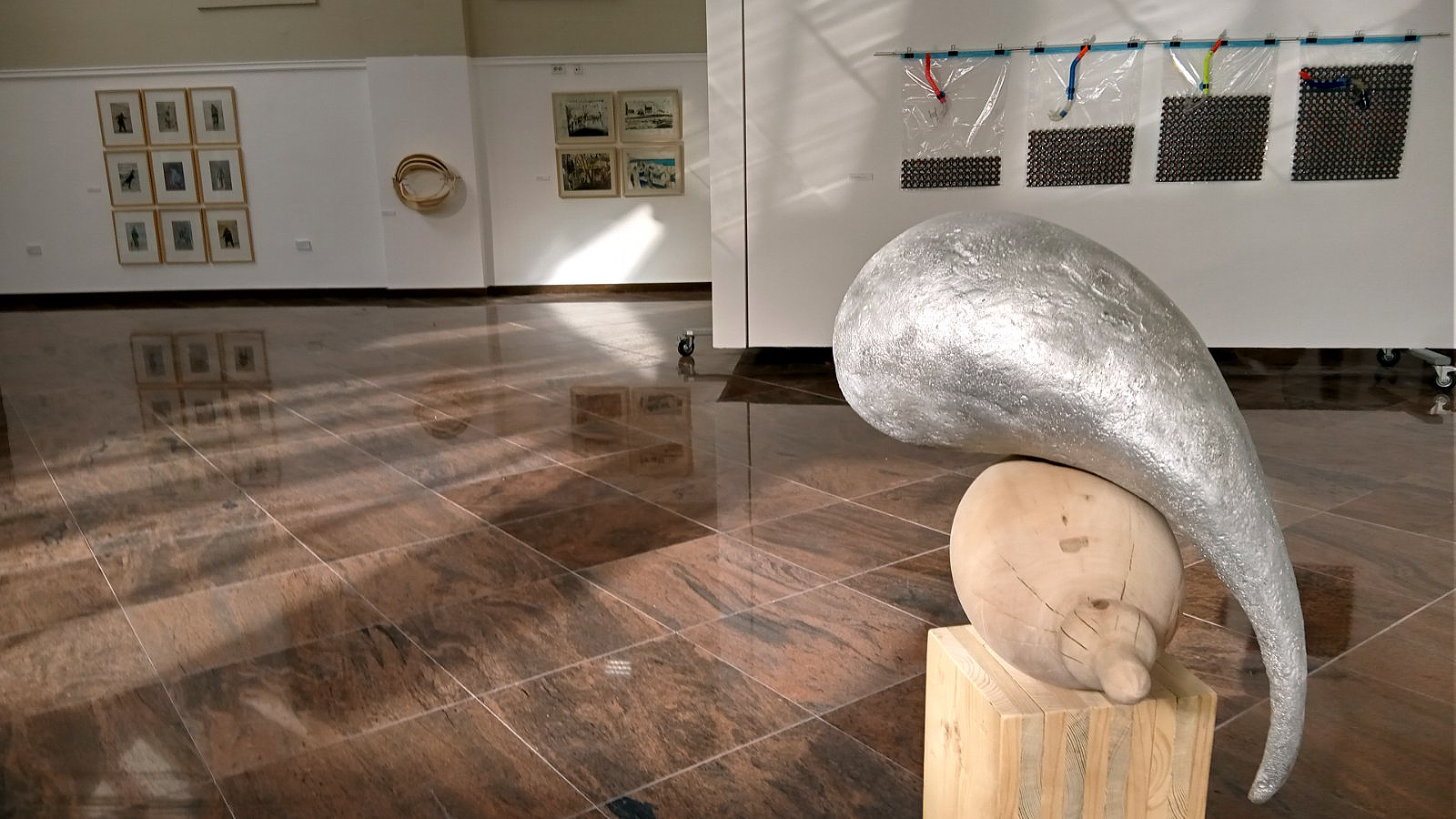
“Liberation” is an exploratory and thematic repertoire of sculptures created in the period 2017-2023, which in a suggestive way conveys new, complex ideas as well as the deeply repressed emotions of the author. By projecting personal emotional states, freed from the constraints of everyday life, through the transformation of matter, Masa Paunović conveys the magnificent idea of freedom, or the multifaceted liberation of thoughts, ideas, souls, matter…
As a sculptor who enters the very core of the material, whether it is wood, stone or metal, she devotes great attention to the dynamic shaping of trapped emotions.
Each of her sculptures exists as an authentic, living organism that is in a state of reshaping or transformation, striving to connect with space, while at the same time emitting a unique form of energy.
Articulating new energetic values, she not only establishes a connection with the viewer, but also generates new spatial visual content, problematizing current topics of contemporary society.
Maša Paunović was born on November 30, 1981 in Belgrade. She graduated in 2005 from the Faculty of Applied Arts in Belgrade, Department of Sculpture, in the class of Prof. Zorica Janković and Prof. Milun Vidić. In the same year, she enrolled in master’s studies and in 2010 she defended her master’s thesis on the topic “Sanduk-duh vremena, Trg Republike, Belgrade” in the field of sculpture. In 2012, she completed a specialization course in the field of artistic metal processing with sculptor Arnaldo Pomodoro, at the “Centro Tam” institute in Italy. At the National Museum in Belgrade, on December 5, 2014, she passed the professional exam and earned the right to the professional title of conservator-restorer.
She has been exhibiting in collective exhibitions since 2002 and has participated in over 100 collective exhibitions in the country and abroad, and has also had 8 solo exhibitions so far:
Art Colony 61st convocation
Art Colony Begins: Artists Create in Sićevo for the Next 10 Days
Last night, the 61st convocation of the oldest art colony in the Balkans was officially opened in the village of Sićevo, where 9 artists from Croatia, Bulgaria and Serbia will be staying for the next 10 days. The artworks created during this year's event will be exhibited in the Pavilion in the Fortress in November 2025.
The Sićevo Art Colony continues the tradition of the first Yugoslav art colony, founded by the famous Serbian painter Nadežda Petrović.
“We are opening this colony with special pleasure, because for us this is the year of the anniversary and 6 full decades of continuous maintenance of the Sićevo Colony. It took a lot of vision, commitment and enthusiasm to bring to life the idea that Nadežda Petrović had in 1905 when she first gathered her colleagues here in the village of Sićevo. Thanks to this, our institution has over 900 paintings, sculptures and new media that we preserve, study, take care of, and occasionally exhibit, and these are works by over 500 authors from our country and abroad,” says Ema Ćoćić Bilić, director of the Gallery of Contemporary Fine Arts.
The opening ceremony was also attended by Prof. Dr. Dejan Antić, State Secretary at the Ministry of Culture, who emphasized his unique position on supporting this significant cultural event.
"It is an honor and a pleasure to be with you tonight. I would like to take this opportunity to convey to the director and all of you the position of Minister Nikola Selaković that the state of Serbia and the Ministry of Culture will continue to support the organization of such a colony. The Ministry has supported the realization of the Colony continuously in previous years, and it will continue to do so in the years ahead," says Prof. Dr. Dejan Antic, State Secretary at the Ministry of Culture. The collection of works of art created in Sićevo is the most valuable collection of our art from the second half of the century in the territory of Serbia proper, both in terms of its historical, artistic and aesthetic characteristics.
City Councilor Milica Paulus said that artists are the most important in a society, and she recalled the words of Nadežda Petrović.
“Artists must be teachers not only of their own people, but of all peoples. Not only of their own, but of all centuries. And true art must be a teacher, educator and fighter for the progress of humanity. We can say that the task and mission of artists and art have not changed to this day. In this name, I wish all participants a pleasant stay and successful work in this wonderful space where artists and nature compete in the beauty of colors and shapes,” says Councilwoman Milica Paulus.
The participants of the Sićevo Art Colony 2024 are: Nina Ivanović, Marija Bogdanović, Đorđe Stanojević (Belgrade), Nikolija Stanojević, Milan Hrnjazović (Valjevo), Borislav Božić (Croatia), Dinko Nenov (Bulgaria), Milan Ristić and Tijana Savković (Niš).
The implementation of this year's event was supported by the City of Niš and the Ministry of Culture of the Republic of Serbia.
Art colony Sićevo 2024.
The Gallery of Contemporary Fine Arts Niš invites you to the grand opening of the Art Colony Sićevo 2024 on Monday, September 2nd at 7 p.m. - Art Colony building in the village of Sićevo.
The Art Colony Sićevo continues the tradition of the first Yugoslav art colony, founded by the famous Serbian painter Nadežda Petrović. As the oldest colony in the Balkans, it was first held in 1905. Since 1964, when its work was renewed, it has been held continuously every year. Thanks to this event, a collection of 1,000 works of art has been formed and, in terms of its historical, artistic and aesthetic characteristics, it is the most valuable collection of our art from the second half of the century in the territory of Serbia proper.
The colony is held every September in the village of Sićevo, 20 km from Niš. In addition to the artists' stay and work, the Work Program, decided by the Event Council, traditionally includes a more detailed introduction of participants to the cultural and historical heritage of this region. During the ten-day stay, participants have the opportunity to visit the Sićeva Gorge, the surrounding monasteries, and the cultural and historical monuments of our city: the Fortress, Mediana, and the Ćele-kula.
The works of art created during this year's event will be exhibited in the Pavilion in the Fortress in November 2025.
The collection of the Sićevo Art Colony is enriched every year with new works that are left for safekeeping, museological processing, protection, and professional presentation in the implementation of the Gallery of Contemporary Fine Arts in Niš.
The participants of the Sićevo Art Colony 2024 are: Nina Ivanovic, Marija Bogdanovic, Đorđe Stanojevic (Belgrade), Nikolija Stanojevic, Milan Hrnjazovic (Valjevo), Borislav Bozic (Croatia), Dinko Nenov (Bulgaria), Milan Ristic and Tijana Savković (Niš).
The implementation of this year's event was supported by the City of Niš and the Ministry of Culture of the Republic of Serbia.
100 out of 1000 works from the collection of the Art Colony Sićevo
On Thursday, August 29 at 8 p.m., the Officers' Home opened the exhibition "100 out of 1,000 works from the collection of the Sićevo Art Colony" to mark 60 years of regular operation of the Colony.
The exhibition is conceptually designed to follow the chronological sequence of the Colony's existence, illustrating its basic characteristics - Yugoslav and international character, openness to artists of different vocations and styles. The exhibition will be realized through two exhibitions, the first of which is based on works created until 1994, and the second exhibition (September 19 to October 10) includes works from the last thirty years. The author of the exhibition is Milica Todorović, museum advisor.
As the participants of the Sićevo Art Colony were protagonists and actors of numerous parallel existing movements and styles, the exhibition also provides insight into recent movements in art in our region from the 1960s to the present, i.e. from Informel and Tachism, oneiric and metaphysical painting, new figuration, various retro styles of the 1980s and postmodern tendencies, to a new understanding of classical painting and electronic painting, i.e. video.
The idea of our famous Serbian painter Nadežda Petrović about gathering artists in Sićevo, which was realized in 1905 within the First Yugoslav Art Colony, was renewed in 1964 at the initiative of the Society of Fine Artists of Niš, with the establishment of the Sićevo Art Colony. At the time of its establishment, the Sićevo Colony was the first art colony in the territory of central Serbia, and today it is a respectable and longest-running art manifestation of the city of Niš, highly respected in the art world.
The Sićevo Art Colony was initially Yugoslav in nature, and since 1982 it has officially acquired the character of an international manifestation, but inviting artists from abroad has become a regular practice since the early 1990s. A total of 545 artists have participated in the work of the Sićevo Colony so far, of which the largest number were artists from Serbia (285), Niš itself (80), the former Yugoslav republics (70), while 110 artists from many European countries and countries from other continents participated.
In line with the First Yugoslav Art Colony, whose prominent member was the sculptor Ivan Meštrović, the Art Colony Sićevo was open from its foundation not only to painters but also to sculptors and graphic artists, which distinguished it from the colonies of the time that were exclusively for painting (Ilok, Senta, Ečka, Počitelj) or sculpture (Portorož, Dečani, Prilep). Thanks to the Art Colony Sićevo, an impressive fund was formed, which currently has exactly 1000 works of art, of which 88 are kept in the National Museum in Niš and 912 in the collection of the Gallery of Contemporary Fine Arts, given that the Gallery has been managing all the work of implementing the Colony since its foundation (1970). The collection of the Art Colony "Sićevo" is a large, authentic and, due to its historical and artistic characteristics, extremely valuable collection of contemporary art.
Although the organizers of the Colony never conditioned or limited the artists in terms of their choice of themes and motifs, a large number of authors directly reacted to the environment in which they created with their work, whether they used the historical and cultural and artistic heritage of this region for their own inspiring mimesis or the natural environment itself, that is, the landscapes of the unique and unrepeatable Sićevo Gorge. Transposing the vital force of powerful nature into the language of visual elements was a challenge that many artists could not resist, approaching it in an inventive way while respecting personal artistic subjectivity.
The exhibition 100 out of 1000 works from the collection of the Sićevo Art Colony contains works by artists of a wide generational range, from Ivan Tabaković and Mihailo Petrov through the generation of Miodrag Protić, Ksenija Divjak, Mića Popović, Boško Karanović, Bate Mihailović, Stojan Ćelić, Leonid Šejka to all subsequent generations and artists active today. Although the exhibition is based on only one tenth of the works from the collection of the Sićevo Colony, we believe that it provides an adequate insight into the value of the collection, with it we mark the sixtieth anniversary of the Colony's existence, but we also remind you that this priceless treasure still does not have the conditions for permanent presentation.
"Trepča" by Ljiljana Šunjevarić
Trepča by Ljiljana Šunjevarić.
Ljiljana Šunjevarić's latest artistic ensemble will be exhibited for the first time in Niš, at the Pavilion in Tvrđava from August 22 to September 15. With these paintings, the artist remains consistent with issues of social reality, but makes perhaps the first more extensive contribution to understanding the living conditions in northern Kosovo in domestic art. The Trepča Mining Complex, which symbolizes the betrayed ideas of socialist workers' progress, indirectly tells us about the policy of restoring Serbia's sovereignty over the province, from the late 1980s and the more than excessive epilogue from the 1990s. However, Ljiljana's paintings mostly thematize the twenty-year transitional vacuum in this territory, the issues of people's lives and endless expectations. Therefore, the artist paints vedutes of this complex in a hilly landscape, genre scenes from the Trepča restaurant, and portraits of the staff and its guests in muted tones. With the Trepča exhibition, Ljiljana Šunjevarić makes precise but open artistic observations and thus provokes a response from the public consciousness.
Ljiljana Šunjevarić was born in 1979 in Užice. She graduated, received her master's and doctorate in painting from the Faculty of Fine Arts, University of Arts in Belgrade. She has been actively exhibiting at solo and group exhibitions in the country and abroad since 2000. She has been awarded in the field of drawing. She is the author of several art projects in public space. She has participated in numerous domestic and international art colonies and workshops. Her works of art are represented in many collections: Collection of Paintings / Period after 1950 of the Museum of Contemporary Art in Belgrade; Collection of Contemporary Art of the Nadežda Petrović Gallery in Čačak; Collection of the Gallery of Contemporary Art in Zrenjanin; Collection of the National Museum in Arandjelovac; Collection of the National Museum in Smederevo; Collection of the City Museum of Belgrade; Collection of the National Museum in Kraljevo; Collection of Contemporary Painting of the Gallery of Contemporary Fine Arts in Niš and in several private collections. She is employed at the Faculty of Arts of the University of Pristina with a temporary seat in Kosovska Mitrovica, with the title of Associate Professor.