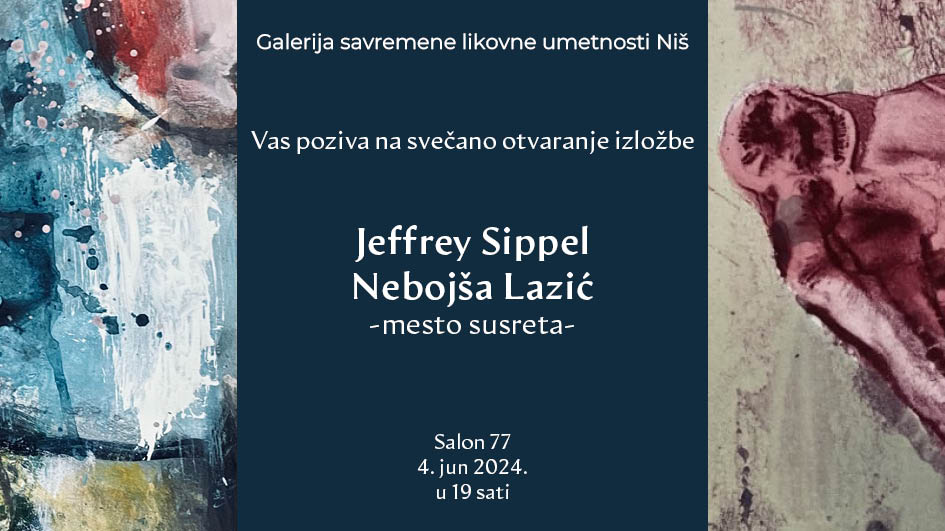
We invite you to the opening of the exhibition of prints by Jeff Sippel and Nebojša Lazić entitled “Meeting Place”
Tuesday, June 4, 2024 at 7 p.m.
Salon 77
Jeff Sippel and Nebojša Lazić are long-time friends and colleagues who have been nurturing a friendship and artistic collaboration for more than thirty years, which began in the 1990s at the Tamarind Institute in New Mexico, United States. The collaboration has been maintained over the past years, through socializing, exchanging ideas in the field of fine graphics, and through the joint work of two artists from different continents. This exhibition, entitled “Meeting Place”, continued in Serbia, first at the Small Art Salon in Novi Sad, then at the Sićevo Print Workshop and finally with this exhibition at Salon 77.
Jeffrey Sippel is an international artist and American printmaker. He graduated from the University of Wisconsin-Eau Claire in 1976 and studied at the Tamarind Institute from 1977 to 1979. After graduating from the Tamarind Institute, he received a certificate as a master printer. Later, he received an MFA from the Arizona State Institute. Sippel taught at Druchaus EA Kuensen, worked as the head printer at Ocean Works LEL and taught at Ohio State University. Sippel currently teaches at the University of Missouri, St. Louis. Specializing in waterless lithography, his work is included in many renowned collections, including the Siminsonian Institute. In addition, Sipel’s many exhibitions include lectures in the Soviet Union, Finland, South Africa, Chile, Belgium, Poland, Germany, Bulgaria, Mexico, Canada, and elsewhere in the United States. Sipel has exhibited his work in over 200 exhibitions throughout the United States and around the world.
He uses floral motifs, abstracting them in shape and form. He works on paper, mylar, or canvas, combining many different layers of printmaking techniques to achieve the desired effects. He considers his visual explorations to be essential inspiration in his work with students, in collaborations with colleagues, and in his own work. Primarily as a printer, he uses applications, printing cliches, combining different layers that often deviate from the original intention. The fundamental elements contribute not only to the visual but also to the analytical aspect and emotional response.
Nebojša Lazić graduated (1992), received his master’s degree (1996) and doctorate (2015) from the Department of Graphics at the Faculty of Fine Arts in Belgrade. During his two-year specialist studies at the Tamarind Institute of Lithography in New Mexico, USA, he earned the title of Associate Printer for Graphics. He has received several awards, scholarships and recognitions for his contribution to fine and graphic arts in the country and abroad. So far, he has organized twenty-three solo and nine author’s exhibitions in the country and abroad. He has been a regular member of ULUS since 1993. During his decade-long stay in New York (1995-2006), Lazić founded a professional lithographic studio in which he collaborated as a collaborative printmaker with Rutgers University in New Jersey, the art studio of Donald Bechler, Stefan Dean, Anna De la Porte, Ray Smith, Sinclair Semin… In the professional graphic studio Lower East Side, he demonstrated lithographic techniques. Since 2014, he has been working at the Academy of Arts in Novi Sad as a professional associate in the subject of drawing, and from 2007 to 2014, he worked in the same position at the Faculty of Fine Arts in Belgrade. He currently holds the title of assistant professor at the Department of Drawing at the Faculty of Arts in Novi Sad and at the Department of Graphics at the Academy of Classical Painting at the EDUKONS University in Sremska Kamenica. Lazić is the founder of the Center for Graphics in Novi Sad in 2008, where, through a series of projects in collaboration with domestic and foreign artists, he organized many author exhibitions in Novi Sad, Pym, New York and Munich. He is a participant in numerous professional symposia in the country and abroad. When it comes to his work, he transferred his visual research in the field of lithography to painting. He builds abstract images in layers, by spilling paint on canvas, with expressive gestures. He consciously creates situations of chaos where “the painting paints itself”, organizing the achieved randomness into an artistic whole.