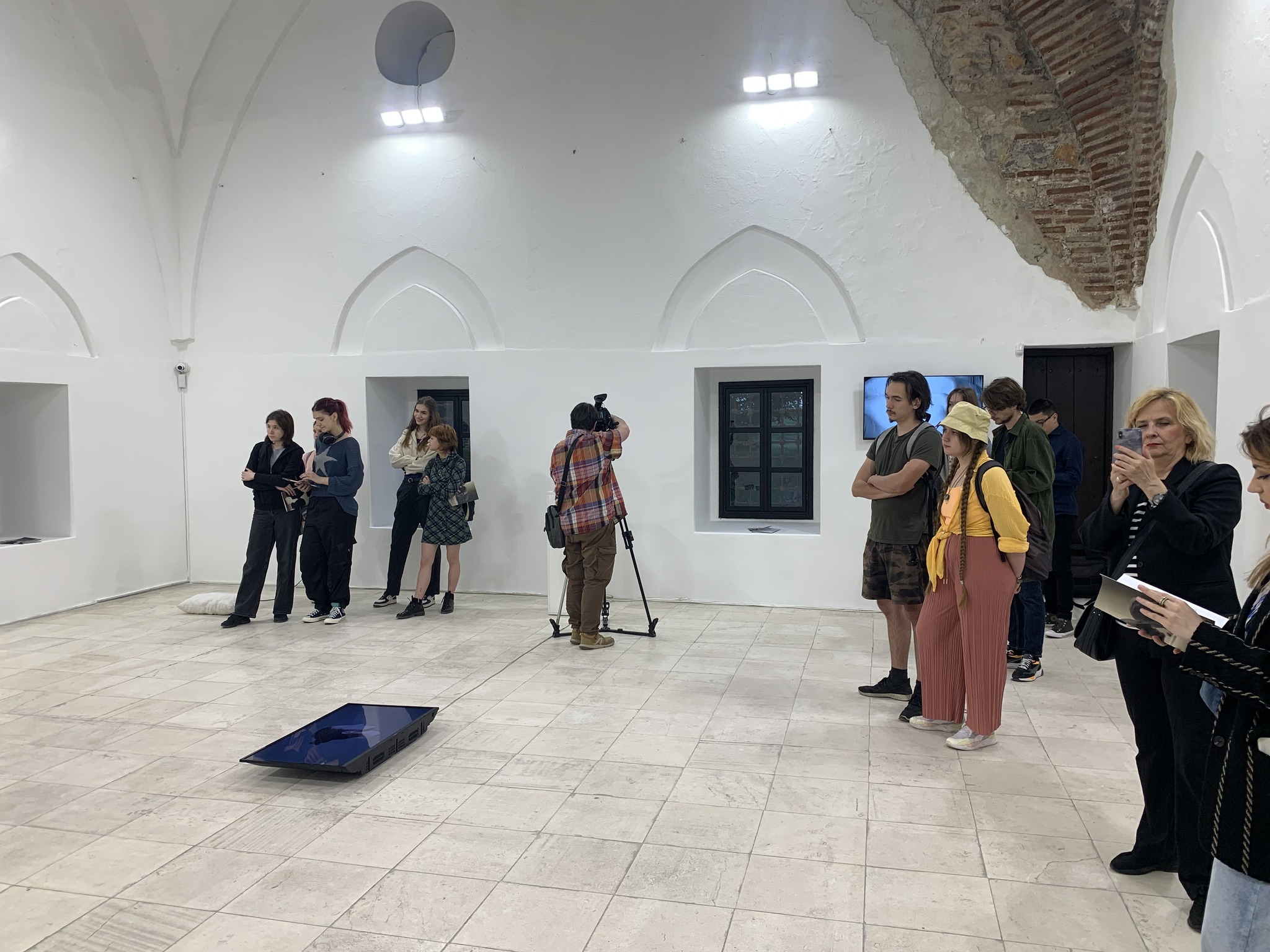
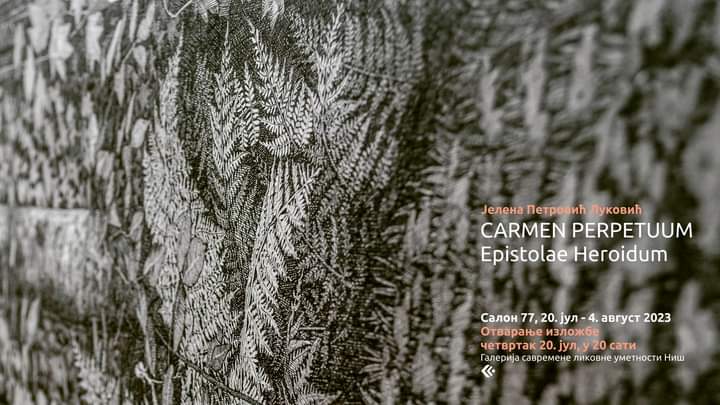
САЛОН 77
ИЗЛОЖБА РАДОВА НЕВЕНКЕ СТОЈСАВЉЕВИЋ
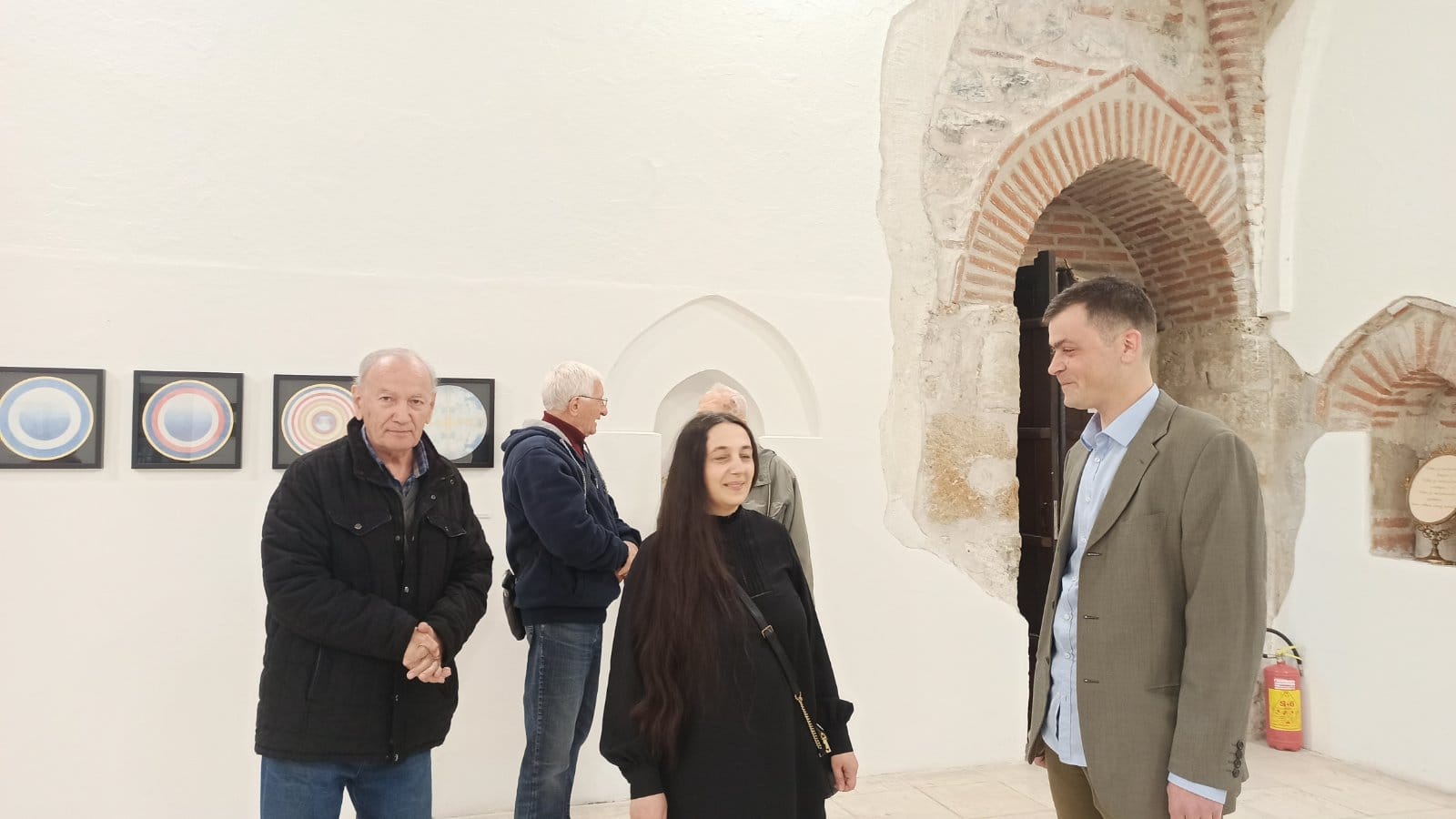
Уметнички опус Невенке Стојсављевић истакнуте београдске графичарке и сликарке представља један од најдоследнијих примера истраживања односа између природе, светлости и графичке материје у савременој српској уметности.
Њен графички лист није само прозор ка природи, већ математички промишљена површина. Радови су чврсто утемељени на јасним осама. Хоризонтала обично сугерише мир, док вертикала даје композицији ритам и стабилност. Динамична геометрија је у њеном раду граматика визуелног језика и разума, док је боја емоција. Управо та синтеза чини њено дело јединственим и препознатљивим у савременој српској графици. Стога, радови функционишу као визуелни алгоритми. Линије се преклапају, ломе и укрштају, стварајући утисак непрекидног кретања унутар строго контролисаног система. Критичари је деклеришу као "уметника истраживача" и "уметника окренутог себи", зато је и њена геометрија истовремено егзактна (научна) и дубоко интроспективна. Употреба металик тонова (сребрне у комбинацији са црном и белом) није декоративна. Она служи за хватање реалног светла у простору галерије, чиме графика престаје да буде статична слика и постаје светлосни објекат. Одсуство јарких боја у најновијим циклусима указује на филозофску зрелост – сведеност на суштину, где контраст светла и сенке мења потребу за нарацијом, можемо рећи да постиже хроматску тишину.
Док су њени ранији радови (70-их и 80-их) били "тешки" од урбаних мотива и текстуре бакрописа, најновији радови на папиру теже дематеријализацији. У сериграфијама постигнута је таква прецизност да облици делују као да лебде. Геометрија овде не "затвара" простор, већ га отвара и чини га прозрачним. Фокус је на структуралности: Линија је постала носилац енергије, а не само граница облика. Најновији опус може се дефинисати као "Математичка духовност".
Стога слободно можемо закључити да је Невенка успела у најтежем уметничком подвигу – хуманизовала је геометрију. Њени најновији радови нису хладне конструкције, већ записи о хармонији космоса. Она је београдску графичку школу извела из оквира традиционалног пејзажа у сферу чисте, етеричне апстракције која комуницира са универзалним принципима реда и светлости. Овим радовима она доказује да геометријска строгост не искључује лирску осетљивост; напротив, код Невенке, једно без другог не може постојати. Она остаје бескомпромисни чувар интегритета графичког листа, претварајући га у савремени портик кроз који посматрач улази у простор тишине и апсолутне равнотеже.
Невенка Стојсављевић је завршила Факултет примењених уметности 1977. године, а посдипломске студије 1980. на Факултету Ликовних уметности у Београду. Студијски боравила у Паризу 2009. године. Награђивана је четрнаест пута за свој уметнички рад. До сада је приредила тридесет осам самосталних изложби, а учесница је на преко 300 колективних у земљи и свету (Француска, Норвешка, Шпанија, Немачка, Белгија, Јапан, Словенија, Македонија, Мађарска, Пољска, Хрватска, Чешка, Босна и Херцеговина, Црна Гора …
Учествовала је на многим симпозијумима у земљи и иностранству. Члан је Удружења ликовних уметника Србије од 1978. године. Радила је као професор у Школи за дизај и на Вишој школи ликовних и примењених уметности у Београду. У Нишу је самостално излагала 1991. и 2005. а била је и учесница Ликовне колоније Сићево. Њени радови налазе се у власништву многих музеја, галерија као и у приватним колекцијама.
Изложба ће трајати до 7. јуна 2026. године.
Nikola Milanov
Nikola Milanov "Monologue of Emotions"
April 21. - May 10. 2026
Salon 77
Nikola Milanov’s solo exhibition, titled “Monologue of Emotions”, features a series of paintings and drawings that the artist began during his undergraduate studies and further expanded during his Master’s studies t the Faculty of Arts in Niš. Intrigued by the question of human emotions and the impact of the environment on their origin and transformation, the artist begins his research by studying personality psychology and re-examining his own being. In a series of portraits and self-portraits, implemented in oil on canvas and mixed media drawing, the artist has turned the emotions of his subjects into various physical expressions to bring us closer to the manner the individuals project their feelings onto the world around them. Fleeting
emotions are immortalized through gestures and distorted facial expressions; thus, expressions of surprise, helplessness, astonishment, and pain, as well as psychological and physical torture, are visible on the depicted faces.
Environmental influences, which are fundamental to creating these reactions, are depicted through red threads attached to the subjects’ eyes and mouths. These threads pull at the features in specific directions, suggesting an invisible force that shapes and controls their expressions. In some instances, the tension is stretched to its limit, prompting the subjects to furrow their brows or tilt their heads in an effort to resist these external pressures. In a number of works, the artist explores the theme of complete constraint, where thicker red lines appear to press firmly against the skin. This completely deprives them of movement, which is why their main means of expression become their eyes and mouth.
Throughout his works, the young artist illustrates how facial expressions serve as a mirror of the individuals′ internal state and the profound impact that society and the environment exert upon them.
Asst. Prof. Andrijana Golac-Čubrilo, PhD
Nevena Kostić "The Other Face of Silence"
Nevena Kostić
The Other Face of Silence
Salon 77, August 26 - September 21, 2025
An excerpt from a dozen drawings from the landscape cycle by artist Nevena Kostić forms a new exhibition at Salon 77. Predominantly using the technique of charcoal on paper, which she mixes with watercolor, pastel, ink and collage, the artist assumes systems of expressive lines with small colored accents, painted or glazed passages, but most often with inverse drawing with an eraser. The tension of the scene in some works manifests the aesthetic category of sublimity, which is somewhat limited today, while in others, the sequence of plans in depth leads the observer to meditative reflections. One gets the impression that the works in which these two treatments meet are particularly successful because they seem to support the thesis that beyond tense situations lies a world of peace, completely immune in its ignorance.
Nevena Kostić (Kragujevac, 1988) completed her undergraduate and master's studies in mural painting at the Department of Applied Arts of the Faculty of Philology and Arts in Kragujevac, in the class of Professor Zoran Ivanovic. She has participated in the work of numerous domestic and international art colonies. She has exhibited in a large number of collective exhibitions, and has realized seven solo exhibitions. She has won four awards for drawing and mosaic. She has been a member of ULUS since 2015.
The exhibition "The Other Face of Silence" can be visited by the public until September 21 at Salon 77.
"Word and/or Image, Ethics and/or Aesthetics" by Irena Vuković
"Word and (or) Image, Ethics and (l) Aesthetics" by Irena Vuković - an artist from Podgorica. The exhibition consists of digital drawings printed on canvas, realized in the last five years.
Irena Vuković was born in 1975 in Titograd. She graduated from the Department of Graphic Design at the Faculty of Fine Arts in Cetinje, in the class of Professor Mile Grozdanić. She received her master's degree in 2020 from the same faculty with the thesis "Graphic Design of the Edition or the Artistic Autonomy of the Book". Since 2014, she has been working as a professor at the Secondary Art School "Petar Lubarda" in Cetinje. She has exhibited solo in Podgorica, Tivat, Herceg Novi, Pančevo, Vranje, Belgrade, Bijelo Polje. She has participated in numerous collective exhibitions, art and creative workshops in the country and abroad. She has been a member of the Association of Fine Artists of Montenegro since 2005. She won the "Good Design" award at the Novi Sad Book Salon (2008) for the graphic design of the "Nobel Prize" edition.
With an interdisciplinary approach, combining the experience of graphic design with painting and drawing, and applying modern technology in its implementation, Irena Vuković develops an indigenous opus based on original visual art and visuality that synthesizes text and image.
Personally, active reflection on contemporary social relations and circumstances opens up a wide range of psychological, ethical, and ultimately existential themes for Irena Vuković, which the artist interprets with a pronounced dose of humor, often with a bitter undertone. Supporting the form of comics, Irena mainly defines scenes in the form of dialogues between figures, often presented on a geometric background that is reminiscent of pixels of electronic images or graphics of old video games. Her figures are expressively caricatured in character with intense yet harmonious colors, and the texts they "pronounce" are either witty wordplay or verses whose form refers to traditional folk literature, while the content reflects contemporary vocabulary and situations.
Irena Vuković is the author of a special mental and emotional code and clear perceptions of the circumstances of her own time. Her works, as inspired visual testimonies of the "new normality" we live in and current models of behavior, provoke reflection on the perspective of living in conditions of shaken humanistic principles.
The exhibition will run until June 23.
"Center" by Andrea Moračan
Andrea Moračanin
"Center"
Lithographs and Projections
Salon 77, May 8 -June 1, 2025
On Thursday at 7 p.m., Salon 77 in Tvrđava will open an exhibition of lithographs and photo-projections by the younger generation artist Adrea Moračanin. The exhibition titled "Center" is the artist's first solo exhibition in Niš, and the gallery in the former Bali-beg mosque is a perfect fit for her recent artistic work. Namely, with a simple and precise system of straight, bright lines on a deep black surface, Andrea Moračanin defines the views of the interior of a residential building. Even if we don't know it, and this is her own childhood home, the development of the themes of temporality, eternity, or death, as Dr. Mina Rakidžić Dostanić notes, is clear. Therefore, the display of this graphic entity (and its extensions) in the space of a former religious building encourages the loading of a new value into the artist's work, which is the view of the home as a sanctuary.
Andrea Moračanin (Kraljevo, 1995) completed her undergraduate (2018) and master's (2019) studies at the Faculty of Fine Arts in Belgrade, at the Department of Painting in the class of Prof. Dobrica Bisenić. She is currently pursuing her doctoral studies at the Department of Graphic Arts, FLU, under the mentorship of Prof. Vladimir Milanović. During her studies, she was a recipient of a scholarship from the Ministry of Youth and Sports, and during her doctoral studies, a scholarship holder from the Ministry of Education, Science and Technological Development, where she was engaged as a student-researcher at the Department of Graphic Arts, Faculty of Fine Arts in Belgrade.
She has participated in over twenty group exhibitions in the country and abroad (Belgium, South Korea, Poland, Romania). In 2022, she stayed at the Academy of Fine Arts in Gdańsk, as part of the "Start In Gdansk" project, where she completed a lithography course. In 2024, as part of the Erasmus+ project, she spent two months on a professional internship in Paris, as a printing assistant at the Michael Woolworth Atelier. She holds an art therapy certificate as part of the "Mad Balkans - transforming psychiatry through art" project organized by the Prostor Association from Belgrade and Oslo Metropolitan University.
Mila Guardiola ''INTERACTIONS''
On Tuesday, April 15, starting at 7 p.m., Salon 77 will host the opening of a solo exhibition by Mila Gvardiol, an artist from Belgrade. The exhibition features paintings from her latest production, which belong to the "Interactions" cycle.
Mila Gvardiol (Belgrade, 1979) graduated from the Faculty of Applied Arts (2004) and received her doctorate from the Interdisciplinary Studies Department of the University of Arts in Belgrade (2012). She is an associate professor and dean at the Faculty of Digital Production in Sremska Kamenica. She taught at the Faculty of Applied Arts in Belgrade from 2015 to 2023. She has held more than 40 solo exhibitions in many cities in Serbia and Croatia. She has exhibited at over 200 collective exhibitions in the country and abroad. She has won 15 awards, including the ULUPUDS Annual Award (2018).
The thoughtful and intellectualized transformation of the scene from the macrocosm into the language of geometric forms and lines with a sensitive coloristic choice is the basis of Mila Guardiola's painting manuscript, while the original motif inspiration is recognized in the architecture of urban environments. The artist sublimates fragments of architecture to the level of basic geometric bodies and forms, neglecting the primary function of architecture and creating works that are abstract in terms of visuality and semantic ambiguity with emotional, psychological, or existential connotations.
Mila Guardiola's latest paintings from the "Interactions" series are dominated by massive cubes that resemble apartment buildings, but they are offset from their axis, slanted, disturbingly tilted, prone to falling. The artist mainly presents them from a lower angle, so that their tops are concentrated around a central whiteness as a light source, or the light source is displaced outside the canvas and illuminates the scene in the form of a prismatic beam. By varying the compositional approach, the way of treating light, and the color scheme (from darker, monochrome to lighter pastel), the artist artistically defines different states of interaction, which results in a variety of general impressions that range from the extreme drama of a high energy charge to the tranquility of the coexistence of subdued energy.
The exhibition of Mila Guardiola in Niš will last until May 6th.
SELMA ĐULIZAREVIĆ EXHIBITION
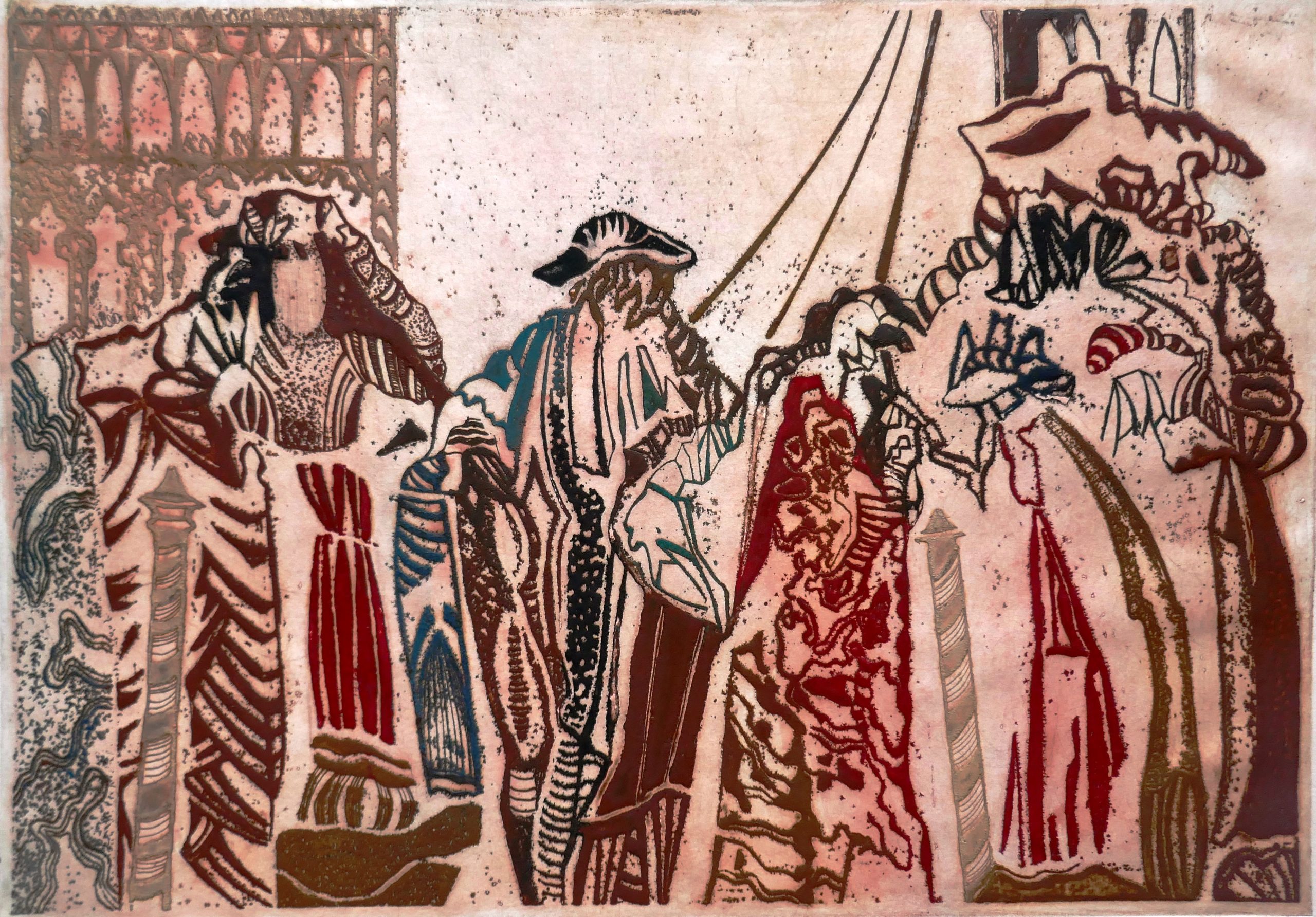
Selma Đulezarević – Karanović was born in Sarajevo in 1967. She studied at the Department of Art History at the Faculty of Philosophy in Belgrade. She graduated from the Painting Department of the Faculty of Fine Arts in Belgrade, in the class of Professor Milica Stevanović. She also completed her postgraduate studies at the same faculty in 1997. She earned a Doctor of Arts degree in painting under the mentorship of Professor Anđelka Bojović in 2012. She has been a member of ULUS since 1995. She currently works at the Faculty of Applied Arts in Belgrade as a full professor. She has had 34 solo exhibitions in Serbia, Montenegro, Bosnia and Herzegovina and Belgium. She has participated in numerous group exhibitions in the country and abroad. Her works are in the collection of the Belgrade City Museum, the Nadežda Petrović Gallery in Čačak, the Contemporary Gallery in Subotica and the Art Gallery of Bosnia and Herzegovina in Sarajevo.
In 2010, Selma Đulezarević Karanović participated in the Symposium of the International Organisation of Scenographers, Theatre Architects and Technicians in Istanbul, entitled Cultural Exchange Between East and West: Kaftan and Its Influence in Fashion. In the same year, she became a member of this organisation. The thematic framework of this symposium had a stimulating influence on her artistic work. Although she is a painter by vocation, she began researching the kaftan, a traditional shirt of the peoples and nationalities from the territory of the former Yugoslavia. Since the author herself comes from Bosnia and Herzegovina, more precisely from Sarajevo, she places emphasis on the urban costume, noticing various depictions and ornaments on the shirts of women of Jewish, Muslim and Christian faiths. One thing was common to all of them, and that was the beauty in the execution of various embroideries and weavings, as well as the dominant floral motif (rose, jasmine, tulip, lily of the valley,..). The importance of folk handicrafts, the richness of weaving in cotton, hemp and silk as well as embroidered decorations on clothing items, shirts, dresses, towels are sublimated in the new opus of Selma Đulezarević Karanović. Following the basic formal principles and patterns in the original embroidery, the artist paints and draws with textile paint floral decorations, song lyrics and messages. Collages made by combining different pieces of textiles have a special charm. This encounter of antiquity with objects of modern clothing creates new horizons not only of the aesthetic but also of the mental concept of a personal nature. The artist uses the white shirt from the folk costume as a metaphor for the permanent and the imperishable, as a symbol of the unbreakable bond of every woman with her mother, grandmother, great-grandmother, generations ago. As the artist herself says, with these works she makes a special kind of gratitude to our ancestors from whom we inherited a sense of beauty. We can freely say that our grandmothers turned manual labor from an everyday necessity into an individual pleasure and a means of expression. Women in domestic conditions, excluded from any socio-political influence and public life of that time, through this type of activity become the forerunners of today's emancipated women. Through various status or romantic messages ("Beauty is within us", "Housewives, talk less so your lunch doesn't burn", "Dew fell on the meadow, I gave my beloved my hand"...) Selma parries the traditional and contemporary position of a business woman, exposed to new global challenges. She has written the verses of Vera Nedić on her wedding towels, her shirts are called "Covid Depression", and her corsets are written with the names of antidepressants. Dresses, collages and other objects make the ambient installation entitled "Heritage-Burden" complex and multi-layered. Going through each segment of the aforementioned works, the artist gives us the opportunity to experience the past and heritage through the prism of the aesthetic, philosophical, material and immaterial segments of our individual and collective heritage, questioning our willingness to accept its weight.
https://www.youtube.com/watch?v=H_uPe1z9XnA
"Liberation" by Maša Paunović
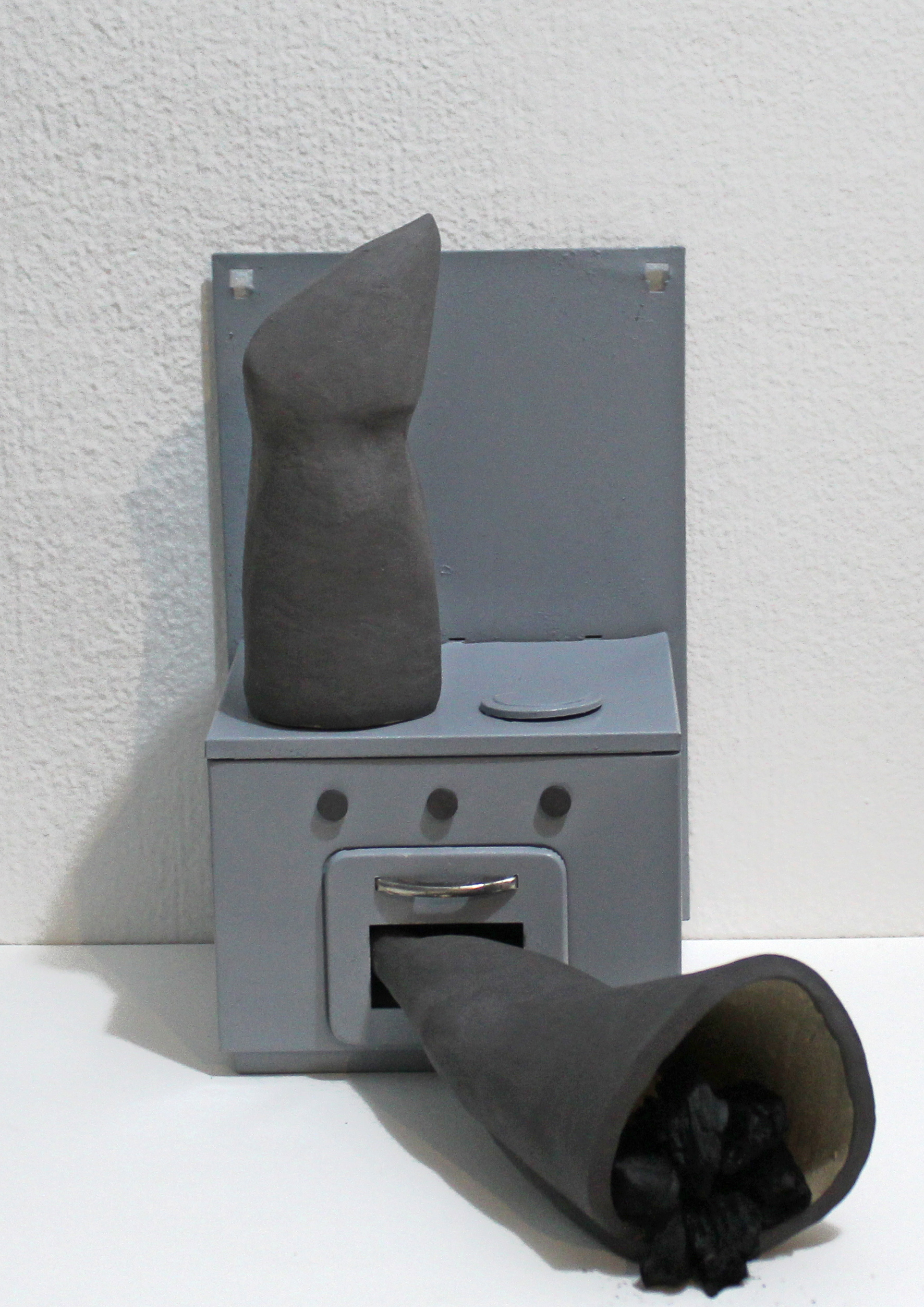
“Liberation” is an exploratory and thematic repertoire of sculptures created in the period 2017-2023, which in a suggestive way conveys new, complex ideas as well as the deeply repressed emotions of the author. By projecting personal emotional states, freed from the constraints of everyday life, through the transformation of matter, Masa Paunović conveys the magnificent idea of freedom, or the multifaceted liberation of thoughts, ideas, souls, matter…
As a sculptor who enters the very core of the material, whether it is wood, stone or metal, she devotes great attention to the dynamic shaping of trapped emotions.
Each of her sculptures exists as an authentic, living organism that is in a state of reshaping or transformation, striving to connect with space, while at the same time emitting a unique form of energy.
Articulating new energetic values, she not only establishes a connection with the viewer, but also generates new spatial visual content, problematizing current topics of contemporary society.
Maša Paunović was born on November 30, 1981 in Belgrade. She graduated in 2005 from the Faculty of Applied Arts in Belgrade, Department of Sculpture, in the class of Prof. Zorica Janković and Prof. Milun Vidić. In the same year, she enrolled in master’s studies and in 2010 she defended her master’s thesis on the topic “Sanduk-duh vremena, Trg Republike, Belgrade” in the field of sculpture. In 2012, she completed a specialization course in the field of artistic metal processing with sculptor Arnaldo Pomodoro, at the “Centro Tam” institute in Italy. At the National Museum in Belgrade, on December 5, 2014, she passed the professional exam and earned the right to the professional title of conservator-restorer.
She has been exhibiting in collective exhibitions since 2002 and has participated in over 100 collective exhibitions in the country and abroad, and has also had 8 solo exhibitions so far:
Sofia Vojinović "Daydreams"
Sofija Vojinović ''Dreaming''
SALON 77
Sofija Vojinović, born in 1991 in Čačak. She completed her master's and basic academic studies at the Faculty of Fine Arts in Belgrade, Department of Painting. She is a member of ULUS.
She has participated in several group exhibitions and has realized four solo exhibitions in Užice, Belgrade, Čačak and Kragujevac. Since 2018, she has been starting her exhibition career with drawings in which she explores the shadow. This project has resulted in the cycles Presupposition, Home in the Home, Shadows of Home and the latest Dreaming.
The shadow in Jung's psychology of personality has a deep meaning and the term shadow refers to a part of identity that the conscious self does not understand or accept. Psychic traits that the human ego does not recognize as its own are instead repressed into the unconscious, where an inferior, dark part of the personality called the shadow is formed. What is even more interesting is that the shadow is an inexhaustible source of creativity and often superb art. Shadows are also mentioned in fairy tales and children's stories, let's remember Peter Pan, the eternal boy who chases his mischievous shadow. The shadow can appear in visions, memories and dreams. That is why the artist turned her shadows into memories that, although faded, have remained permanently recorded in special folders and memory cards. A shadow on the wall, a shadow on the floor, a shadow from a window with outlined traces of a curtain through which, as the wind blows, patterns are created on the wall, outlines of silhouettes, geometric and amorphous forms like the shadows of a home. This interweaving represents the memory of childhood, events from the past, beautiful unforgettable moments experienced in youth, in life, but also repressed difficult, emotional moments that occasionally surface.
The latest cycle of Daydreaming builds on previous cycles, shadows revive memories, and new fragments remain framed within the drawing, frozen in time. Daydreaming is a characteristic of artists, poets, inventors, philosophers. Many scientific achievements, imaginary landscapes of visual artists, beautiful symphonies of composers can arise from daydreaming. They have the power to materialize their daydreaming and transform it into a painting, music, or song.
Shadows on walls, drawings, and canvases by Sofija Vojinović represent geometric compositions with a pronounced perspective, painted in gray layers of transparent paint with visible overlapping of crossed lines and surfaces. Discreetly presented combinations of vertical and horizontal surfaces, bordered by a shadow through which light passes, create a certain contrast that is very important in fine art. This contrast enhances the excitement of the composition. However, the artist places special emphasis on the shadow, which is dominant in the entire composition. Judge for yourself whether visualization is the only important thing or the artist is just playing around in order to draw our attention to listening to our Self a little better, and accepting it as it is without any restraints or complexes.
Spreads # ...
JELENA JOCIC EXHIBITION: "PROSTIRANJA"
"SALON 77" /July 16 - August 7/
She was born in Belgrade in 1970. She graduated from the Faculty of Fine Arts in Belgrade in 1997, at the Department of Graphics, received her master's degree in 2000, and received her doctorate and the title of Doctor of Arts at the Faculty of Fine Arts within the University of Arts in Belgrade in 2017. During her undergraduate studies, she was a recipient of a scholarship from the Republic Foundation for the Development of Scientific and Artistic Youth of Serbia. In the period from 1998 to 2002, as part of a project for talented individuals, she worked at the Department of Graphics at the Faculty of Fine Arts in Belgrade.
Since 2003, she has been working as a professor of professional studies at the Academy of Professional Studies Polytechnic, at the Department of Design. So far, she has had several solo exhibitions and over two hundred group exhibitions in the country and abroad. She has exhibited in New York, Paris, Luxembourg, Liege, Quebec, Thessaloniki, São Paulo, Seoul, Madrid, Budapest, Istanbul, Stockholm, Skopje and at many international graphic arts biennials and triennials. She is the winner of several awards in the field of graphic art (Petar Lubarda, Đorđe Andrejević – Kun, 8th and 9th Biennial of Yugoslav Student Graphics).
The most significant awards in the field of graphics are:
The Graphic Collective Mali Pechat Award in 2010 and the Veliki Pechat Award in 2021. The work "Bridges" is in the collection of the Belgrade City Museum. Her works are included in the Purchase of Works of Art of the Ministry of Culture and Information of the Republic of Serbia (2005, 2014, 2015, 2016, 2018). She has been a member of the Association of Fine Artists of Serbia (ULUS) since 1998, and on the board of directors of ULUS from 2022-2023. She has been a member of the Artistic Council and the board of directors of the Grafički kolektiv Gallery in Belgrade since 2011. She was elected as the president of the board of directors of the GK at the GK assembly held on 06.07.2023.
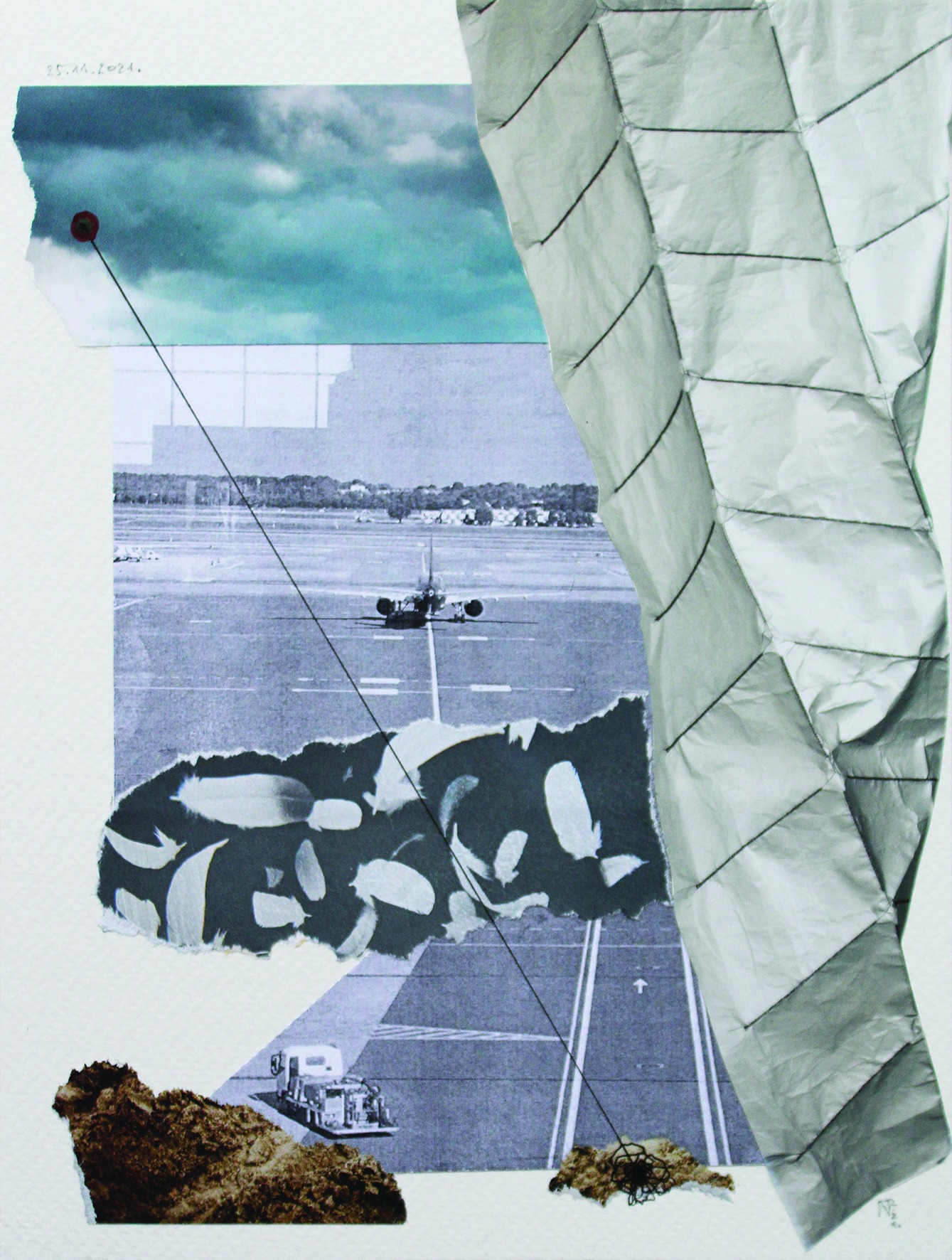
Jelena Jocić continues her artistic research, relating to the existing interiors of large industrial centers, finding in them the idea for defining an ideal space. By merging the visual and the perceptual into one whole, he develops a unique artistic language in whose context visions of an ideal space can be glimpsed. Through his own photographic observation, he singles out the dominant motif of empty, devastated industrial complexes, approaching the framing process that hints at transience, alienation and loneliness. Continuing the process of creation, in addition to nurturing visual relationships, the network of crossed lines and collage pop art pieces also includes a certain number of artifacts.
Through the play of light and geometric surfaces, as well as the assembly procedures used by constructivist artists, he explores the boundaries of personal and private space.
The architectural specificity of the interior, which associates with metal structures, served as a metaphor for the boundary that separates the artist from the existing environment, entering new timeless dimensions.
https://www.youtube.com/watch?v=Lb39KY7LJdE